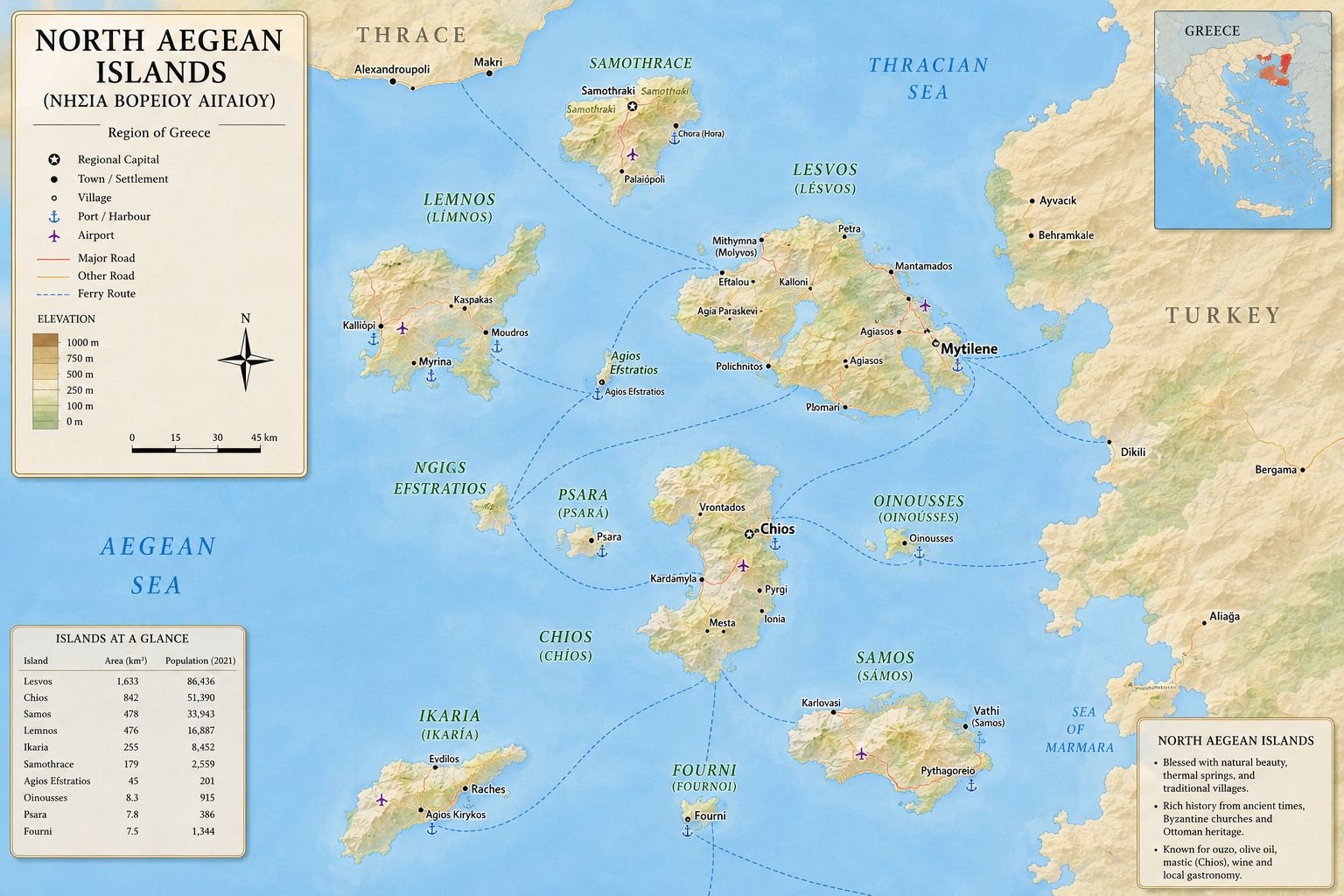
When travelers dream of Greece, they often picture the whitewashed buildings of Santorini, the buzzing nightlife of Mykonos, or the historic landmarks of Crete. But for those seeking a deeper, more authentic, and dramatically beautiful experience, the North Aegean region offers a world apart. Scattered like ancient jewels in the northeastern corner of the Aegean Sea, close to the coast of Asia Minor, lie the islands of the North Aegean: Ikaria, Samos, Chios, Lesvos (Lesbos), Lemnos, and the lesser-known Agios Efstratios. These are islands of wild mountains, deep history, unique local traditions, and a slower, more profound rhythm of life.
This region is not about packaged luxury or crowded beaches. It is a destination for explorers, hikers, foodies, and spiritual seekers. It is a place where you can bathe in therapeutic radioactive springs, hike through petrified forests, taste some of the finest ouzo in the world, and dance at all-night panigyria (traditional festivals) that have remained unchanged for centuries.
Let us embark on a detailed journey through the distinct character of each major island in this captivating region.
Island 1: Samos – The Green Paradise of Hera & Pythagoras
Samos, just a mile from the Turkish coast, is a lush, mountainous island known as the birthplace of the philosopher Pythagoras and the mathematician Epicurus. Its fertile valleys are covered in vineyards producing the sweet, world-famous Muscat wine.
Top Attractions & Activities:
The Tunnel of Eupalinos: An engineering marvel from the 6th century BC, this is a 1,036-meter-long tunnel carved through a mountain to supply the ancient city with water. You can actually walk through a portion of it.
Heraion of Samos: A UNESCO World Heritage site, this massive ancient sanctuary dedicated to the goddess Hera was one of the most important religious centers of the ancient Greek world.
Pythagoreion: The ancient, fortified port of Samos, now a charming town with a beautiful harbor lined with seafood tavernas.
Vathy: The island’s modern capital, a picturesque town with a fascinating archaeological museum housing the famous “Kouros of Samos,” a 5.5-meter marble statue.
Beaches: For organized swimming, head to Tsamadou or Kokkari. For a wilder experience, seek out the remote pebble beach of Mikali or the dramatic Mykali Bay.
Travel Tip: Rent a car or scooter. The island is large and mountainous, and the best coves and mountain villages are off the main roads. Do not miss a wine tasting at a local winery.
Island 2: Ikaria – Where People Forget to Die
Ikaria is world-famous for one thing above all: longevity. It is one of the world’s five “Blue Zones,” where a strikingly high percentage of the population lives past 90. Their secret? A slow pace of life, a strong sense of community, a Mediterranean diet, and the habit of drinking herbal mountain tea. Ikaria has its own time zone—”Ikarian Time,” which essentially means never being in a hurry.
Top Attractions & Activities:
Therma (Agios Kirykos): The island’s capital is famous for its radioactive thermal springs, believed to alleviate arthritis and skin conditions. The spa town has several public baths.
The Castle of Koskina: A medieval fortress offering incredible views over the island and the sea.
Seychelles Beach: A stunning, remote cove with turquoise water and large white pebbles, accessed via a steep, unpaved road followed by a short climb. It is well worth the effort.
Panigyria (Traditional Festivals): From Easter to October, villages take turns hosting all-night festivals honoring a saint. There is spontaneous Greek dancing, unlimited wine, and roasted goat. This is the soul of Ikaria.
Travel Tip: Do not plan a rigid itinerary. You will get frustrated. Embrace the slow pace. Stay in a traditional guesthouse in a mountain village like Christos Raches to experience real Ikarian life. Try the local red wine, which is rich in antioxidants.
Island 3: Lesvos (Lesbos) – The Muse of Poets & Olive Groves
Lesvos is the third-largest Greek island, a sprawling land of two “bays” creating a shape like a leaf. It is the birthplace of the ancient poet Sappho and, today, a place of immense natural beauty and cultural heritage. It is covered in an estimated 11 million olive trees, producing exceptional olive oil.
Top Attractions & Activities:
The Petrified Forest of Sigri: A UNESCO Global Geopark. Millions of years ago, volcanic ash covered a forest, turning the trees into stunning fossils. The park and nearby Natural History Museum are unforgettable.
Molyvos (Mithymna): One of the most beautiful medieval towns in Greece. A hilltop Genoese castle dominates a cascade of stone houses and red-tiled roofs leading down to a charming harbor. The sunset from the castle walls is magical.
Ouzo Distilleries: The island is the spiritual home of ouzo. Take a tour of a traditional distillery in the town of Plomari, where you can see the copper stills and taste the anise-flavored spirit alongside fresh seafood.
The Roman Aqueduct of Moria: A striking, 170-arch, 2.5 km-long aqueduct just outside the capital, Mytilene. It is a majestic sight, especially at sunset.
Travel Tip: Lesvos is large; you will need a car. Spend time in both the north (Molyvos, Petra) and the south (Plomari, Vatera beach). The island also features a large wetland, the Kalloni Gulf, which is a paradise for birdwatchers.
Island 4: Chios – The Island of Mastic & Medieval Villages
Chios is an island of secrets. Its famed “mastic” (a resin from the mastic tree, known as “tears of Chios”) is a unique natural product, once as valuable as gold. The protected mastic villages in the south are a world unto themselves, built like fortresses to protect the precious harvest from pirates.
Top Attractions & Activities:
Mastic Villages (Mastichochoria): The villages of Pyrgi (famous for its unique black-and-white geometric sgraffito-decorated facades), Mesta (a perfectly preserved, fortified labyrinth of medieval houses), and Olympi are a living museum.
Nea Moni Monastery: A stunning 11th-century Byzantine monastery, a UNESCO World Heritage site renowned for its exquisite golden mosaics, which rival those of Ravenna and Istanbul.
Anavatos: A spectacularly eerie “ghost village” perched on the edge of a deep ravine. Abandoned after the 1822 massacre, it offers a haunting and powerful experience.
Vroulidia Beach: A remote, pebbly cove accessible only by a winding road or a hike, known for its deep, clear blue water and dramatic cliffs.
Travel Tip: Try “mastiha” in all its forms: the natural chewing gum, a liqueur, a spoon sweet, and in savory sauces. For a beach day, head to the long, sandy beach of Karfas or the wilder Mavra Volia, famous for its black volcanic pebbles.
Island 5: Lemnos – The Aegean’s Wild West
Lemnos feels different—low, sandy, and windswept, unlike the lush, mountainous neighbors. It is an island of dramatic volcanic rock formations, endless golden beaches, and important wetlands. It is also a sacred island, home to the cave sanctuary of the god Hephaestus.
Top Attractions & Activities:
Poliochni and Kavirio: The ruins of one of the oldest prehistoric settlements in Europe (Poliochni) and a sanctuary of the mysterious Kavirio mysteries.
The Petrified Sand Dunes of Gomati-Lady: A unique geological phenomenon where wind and time have sculpted sandstone into mushroom-like and lunar rock formations.
Desert of Lemnos (Ammos Beach): A surreal landscape of white sand dunes stretching along a turquoise sea near the village of Katalakko. It feels like the Sahara meeting the Aegean.
Myrina: The island’s beautiful capital, crowned by a Venetian castle on a rocky peninsula. The harbor front is lined with excellent fish tavernas, and two fantastic beaches (Romeikos Gialos and Riha Nera) are within a 10-minute walk of the center.
Travel Tip: Lemnos is a paradise for windsurfers (Keros Beach is a top spot) and for families, thanks to its many shallow, sandy beaches. It is also famous for its local cheese, “kalathaki” (a soft white cheese), and “flomaria” (handmade pasta).
Practical Information for Your North Aegean Trip
Getting There: The main islands (Samos, Chios, Lesvos, Lemnos) have airports with domestic flights from Athens (Aegean Airlines, Sky Express). There are also frequent and long ferry connections from the port of Piraeus in Athens and from the northern city of Thessaloniki. Ferries often stop at multiple islands, making island-hopping possible, though timetables can be sparse in winter.
Best Time to Visit: May-June and September-October are ideal. The weather is warm, the sea is pleasant, and the summer crowds (which are never as bad as in the Cyclades) are gone. July and August are hot and windy, but the Meltemi wind is strong here, providing a natural air conditioning.
Getting Around: A rental car is essential for exploring any of these islands thoroughly. Roads can be winding, but the rewards are empty beaches and authentic villages. Scooters are fine for shorter distances on flatter islands like Lemnos.
Food & Drink: Do not miss fresh local seafood, grilled octopus, fava (yellow split pea puree), wild greens (horta), goat or lamb cooked in a wood-fired oven, and for dessert, spoon sweets (glyka koutaliou). Each island has its own special product: Samian Muscat wine, Lesvian ouzo and olive oil, Chian mastic-infused liqueur, Ikarian honey and herbal tea, and Lemnian kalathaki cheese.
Conclusion: The Authentic Greek Experience
The North Aegean islands are not for the casual tourist seeking a simple tan and a cocktail, though you can certainly find those things. They are for the curious traveler who wants to hear the echoes of ancient history, feel the texture of a unique culture, and taste a way of life that has resisted the tide of mass tourism.
Here, you can hike through a petrified forest, soak in radioactive springs, wander through a labyrinthine medieval village, and dance with a 90-year-old at a festival at 2 AM. You will leave with not just a tan, but with stories, friendships, and a profound sense of having discovered the real Greece. Pack your curiosity and a sense of adventure—the North Aegean is waiting.
Leave a Reply
You must be logged in to post a comment.