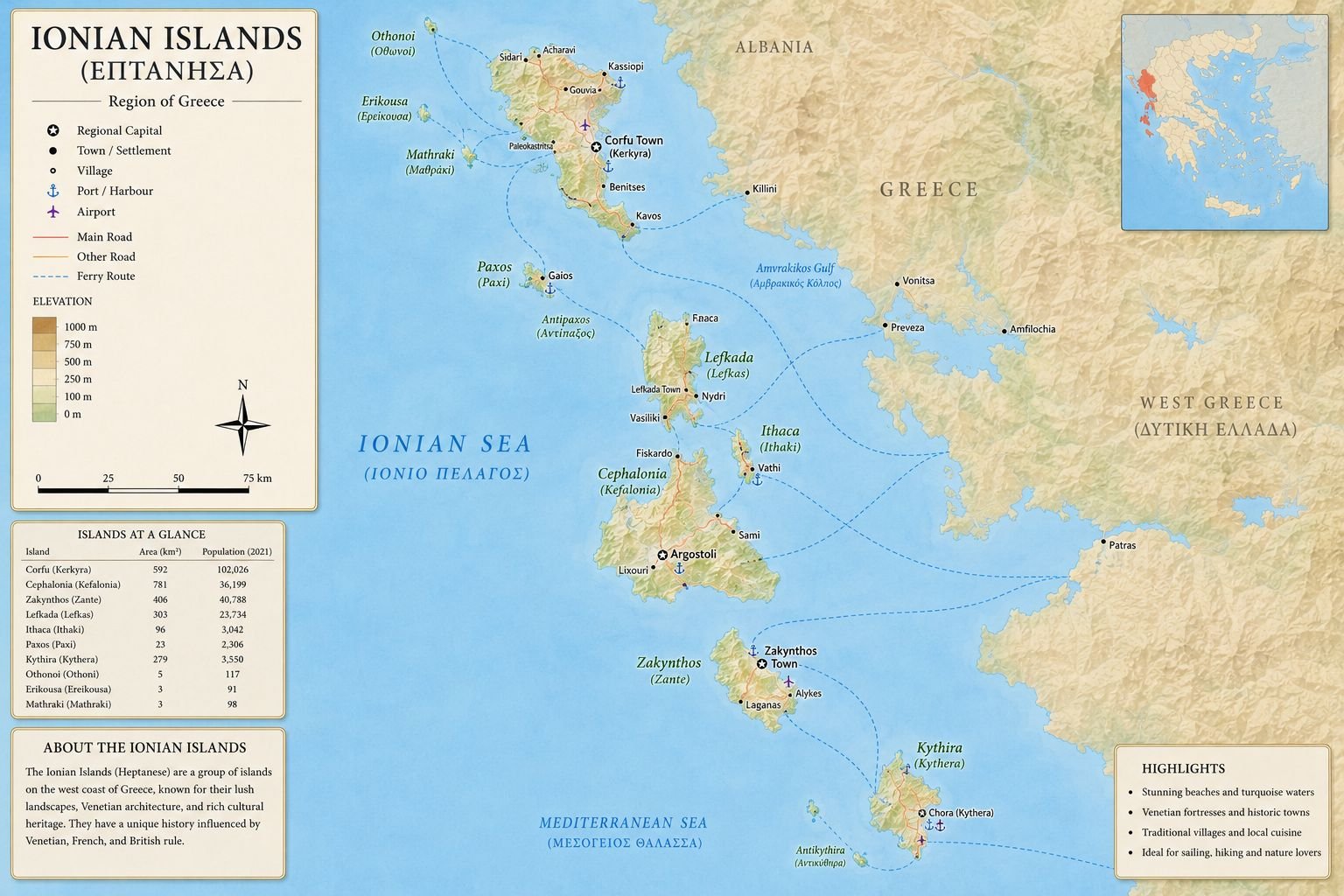
Of all the Grecian archipelagos, the Ionian Islands are the most emerald, the most romantic, and arguably the most distinct. Stretched like a string of seven jewels down the western coast of Greece, this region – known in Greek as Eptánisa (The Seven Islands) – offers a travel experience far removed from the stark, sun-bleached drama of the Cyclades. Here, dramatic limestone cliffs plunge into turquoise waters, Venetian architecture lines marble-paved alleys, and the landscape is so lush with olive, cypress, and pine that Homer himself called it “the floating forest.”
This is your complete guide to the Ionian Islands region: Corfu, Paxos, Lefkada, Ithaca, Kefalonia, Zakynthos, and Kythira.
CORFU (Kerkyra): The Opulent Venetian Lady
Corfu is the gateway to the Ionians, served by an international airport and a major ferry port. The island’s capital, also called Corfu Town, is a UNESCO World Heritage site – a living museum of Venetian, French, and British influences.
- Must-See: The two imposing fortresses flanking the old town; the Liston arcade (a French-style café hub); the Palace of St. Michael and St. George; and Spianada Square, the largest square in Greece.
- Natural Beauty: Paleokastritsa Monastery sits on a breathtaking bay of six coves. For a unique swim, head to Canal d’Amour (Channel of Love) in Sidari, where smooth sandstone channels create natural pools.
- Tip: Rent a car to explore the interior villages like Pelekas, where Kaiser’s Throne offers a panoramic sunset over the entire island.
PAXOS & ANTIPAXOS: The Quiet Aristocrats
A short hydrofoil ride south of Corfu, Paxos is for those seeking serenity. It’s a low, olive-covered island with no airport, meaning crowds are minimal.
- Must-See: The eerie, spectacular sea caves of Erimitis and the blue grottoes of Ortholithos. Take a day boat to Gaios, the main port, with its tiny islets (Panagia and Agios Nikolaos) guarding the harbor.
- Antipaxos: A five-minute taxi-boat ride away, this tiny isle is famous for two things: its own wineries producing light red wine, and Voutoumi Beach – a crescent of white sand lapped by water so clear it looks like liquid sapphire.
- Tip: Book a private boat tour from Gaios harbor. The captains know every hidden cove.
LEFKADA: The Windsurfer’s Paradise
Unlike its sisters, Lefkada is a former peninsula – a narrow drawbridge connects it to the mainland. This makes it easily accessible but no less spectacular. It’s the island of vertiginous cliffs and blinding white beaches.
- Must-See: Porto Katsiki and Egremni – two of the most photographed beaches in the world. You descend hundreds of steps to reach sands backed by stark white chalk cliffs. For windsurfing, Vasiliki is a world-class mecca thanks to daily afternoon thermal winds.
- Inland: Visit the Dimosari Waterfalls, a cold, refreshing plunge pool accessible via a short hike through a gorge.
- Tip: Arrive at Porto Katsiki before 9:00 AM in July/August to secure parking and a sunbed. For a quieter alternative, try Kathisma Beach.
ITHACA: The Legendary Homeland
Ithaca is small, mountainous, and spiritually powerful – forever linked to Homer’s Odysseus. It has no airport and limited ferry service, which preserves its raw, authentic soul.
- Must-See: The Archaeological Museum of Vathy (the island’s charming capital); the Cave of the Nymphs (where Odysseus supposedly hid the Phaeacians’ gifts); and the ruins of a Hellenistic triple-tiered cistern called Arethousa.
- Walking: Ithaca is a hiker’s dream. The trail from Stavros to the School of Homer (a Mycenaean-era site) offers views over the channel to Kefalonia.
- Tip: Don’t expect nightlife. Come here for swimming in secluded coves like Gidaki (accessible by boat or a steep 30-minute hike) and reading under olive trees.
KEFALONIA: The Big, Bold Beauty
The largest of the Ionians, Kefalonia is an island of massive scale – deep gorges, giant caves, and grand views. It was made famous by the novel and film Captain Corelli’s Mandolin.
- Must-See: Melissani Cave Lake – a surreal, partially collapsed cavern where you float on a boat under a shaft of sunlight that turns the water electric blue. Then, nearby, Drogarati Cave with incredible acoustics (it’s used as a classical music venue). Finally, Myrtos Beach – a dramatic sweep of white pebbles between vertical karst mountains.
- Fishing Villages: Fiscardo in the north survived the 1953 earthquake that rebuilt most of the island. Its pastel Venetian houses now host elegant yachts and fine seafood tavernas.
- Tip: Drive across the island’s spine to the Ainos National Park, home to the endangered wild horse and endemic fir trees – it feels like the Alps above the sea.
ZAKYNTHOS (Zante): The Marine Guardian
Zakynthos is famous for two things: the most jaw-dropping shipwreck beach in the world, and its role as a nesting ground for the endangered loggerhead sea turtle (Caretta caretta).
- Must-See: Navagio (Shipwreck) Beach. You can only see it from the viewing platform on the cliff (arrive early to beat bus tours) or arrive by boat – the rusty smuggler’s ship on blinding white sand is an unforgettable sight.
- Conservation: The southern beaches of Laganas Bay, particularly Sekania and Marathonisi (Turtle Island), are protected zones. You can take legal turtle-spotting tours but must follow strict rules (no flash photography, maintain distance).
- Blue Caves: On the northern tip, these vertical, sea-eroded grottos are best explored by small boat – the water inside glows deep cobalt.
- Tip: The town of Zakynthos has a charming central square (Solomos Square) and a Venetian castle on the hill. For nightlife, Laganas is the party epicenter – avoid it if you seek peace.
KYTHIRA: The Distant Cousin
Set far to the south, almost midway between the Peloponnese and Crete, Kythira is often forgotten but beloved by those who find it. It’s fertile, windswept, and full of Byzantine castles and waterfalls that flow directly into the sea.
- Must-See: The Venetian fortress of Chora (the capital), perched on a rocky headland, and the nearby Fonissa Waterfall – a multi-tiered cascade that ends in a freshwater swimming hole. Also, the cave at Agia Sofia with stalactites and ancient Christian frescoes.
- Tip: Kythira’s airport is inconsistent; most visitors arrive by ferry from Neapoli (Peloponnese) or Antikythera. Rent a 4×4 – the roads to remote beaches like Fyri Ammos are rough.
PRACTICAL TRAVEL INFORMATION
Best Time to Visit: May-June and September-October are ideal. The sea is warm, the crowds are gone, and the sun is potent but not scorching. July-August is peak season – ferries book out, hotels double in price, and beaches are packed.
Getting There & Around:
- By Air: International airports on Corfu (CFU), Kefalonia (EFL), Zakynthos (ZTH), and Aktio (near Lefkada, PVK). Seasonal direct flights from most major European cities.
- By Ferry: Regular car ferries connect the islands to each other and to the mainland ports of Igoumenitsa, Patras, and Kyllini. The “Ionian Islands” route makes a great island-hopping itinerary, though note that Kythira is on a separate southern loop.
- On the Islands: Car or scooter rental is essential outside the main towns. Bus services exist but are infrequent and mostly for school routes.
Food & Drink (What to Eat):
- Bourdeto: A fiery, red spicy fish stew (a Venetian legacy).
- Pastitsada: Corfu’s signature – rooster or veal cooked in a rich tomato sauce with cinnamon, cloves, and garlic, served over thick pasta.
- Strapatsada: Scrambled eggs with fresh tomatoes, feta, and oregano – a perfect breakfast.
- Mantoles: Almond brittle candies popular in Kefalonia.
- Wine: Try the dry white Robola from Kefalonia’s mountain vineyards, or the sweet red Mavrodafne of Zakynthos.
- Olive Oil: The Ionian forests produce some of Greece’s most buttery, mild extra virgin olive oil. Buy a tin.
Cultural Etiquette & Tips:
- Nudity: Officially illegal on all public beaches in Greece. Tolerated on isolated coves, but never near turtle nesting zones (rangers are active on Zakynthos).
- Siesta: Between 15:00 and 17:00, many shops and some tavernas close. Use this time to nap or swim.
- Caretta-Caretta: On Zakynthos, do not use white lights on the beach after dark (they disorient hatchlings). Use the red-filter setting on headlamps.
- Earthquake Awareness: The Ionians are seismically active. Your accommodation will have a safety card – read it. That said, modern buildings are earthquake-resilient.
SAMPLE 10-DAY ISLAND-HOPPING ITINERARY
- Days 1-3: Fly into Corfu. Explore Corfu Town. Day trip to Paleokastritsa and Canal d’Amour.
- Day 4: Morning hydrofoil to Paxos (1 hr). Overnight in Gaios. Swim at AntiPaxos.
- Day 5: Hydrofoil to Lefkada (via Igoumenitsa, approx 3 hrs). Rent a car. Drive to Porto Katsiki for sunset.
- Days 6-7: Drive to Vasiliki. Windsurf or hike to Dimosari Waterfalls. Early ferry to Kefalonia (Fiskardo).
- Days 7-8: Kefalonia – Melissani Cave, Myrtos Beach, overnight in Fiskardo or Argostoli.
- Day 9: Ferry to Zakynthos (2 hrs). View Navagio from the clifftop. Stay in the north for quiet, or town for history.
- Day 10: Morning turtle-spotting tour in Laganas Bay. Fly out from Zakynthos (ZTH) via Athens or directly to a European hub.
Note: Adding Ithaca or Kythira requires more time – save them for a second, slower trip.
FINAL VERDICT
The Ionian Islands region is not the Greece of whitewashed cubes and vivid blue domes. It is the Greece of wild rosemary on a hillside path, of a forgotten Venetian cannon overlooking an English-built road, of a sea so clear that your boat seems to float in air. It is softer, greener, and more emotional.
Whether you come for the shipwreck of Zakynthos, the caves of Kefalonia, the windsurfing of Lefkada, or the quiet poetry of Ithaca, you will leave with salt in your hair and a promise to return. Because, as the local saying goes: “Once you drink the water of the Ionian, you will always hear it calling your name.”
Safe travels – kaló taxídi.