Category: Regions

  • Ionian Islands: The Seven Jewels of the Emerald Sea

    Ionian Islands: The Seven Jewels of the Emerald Sea

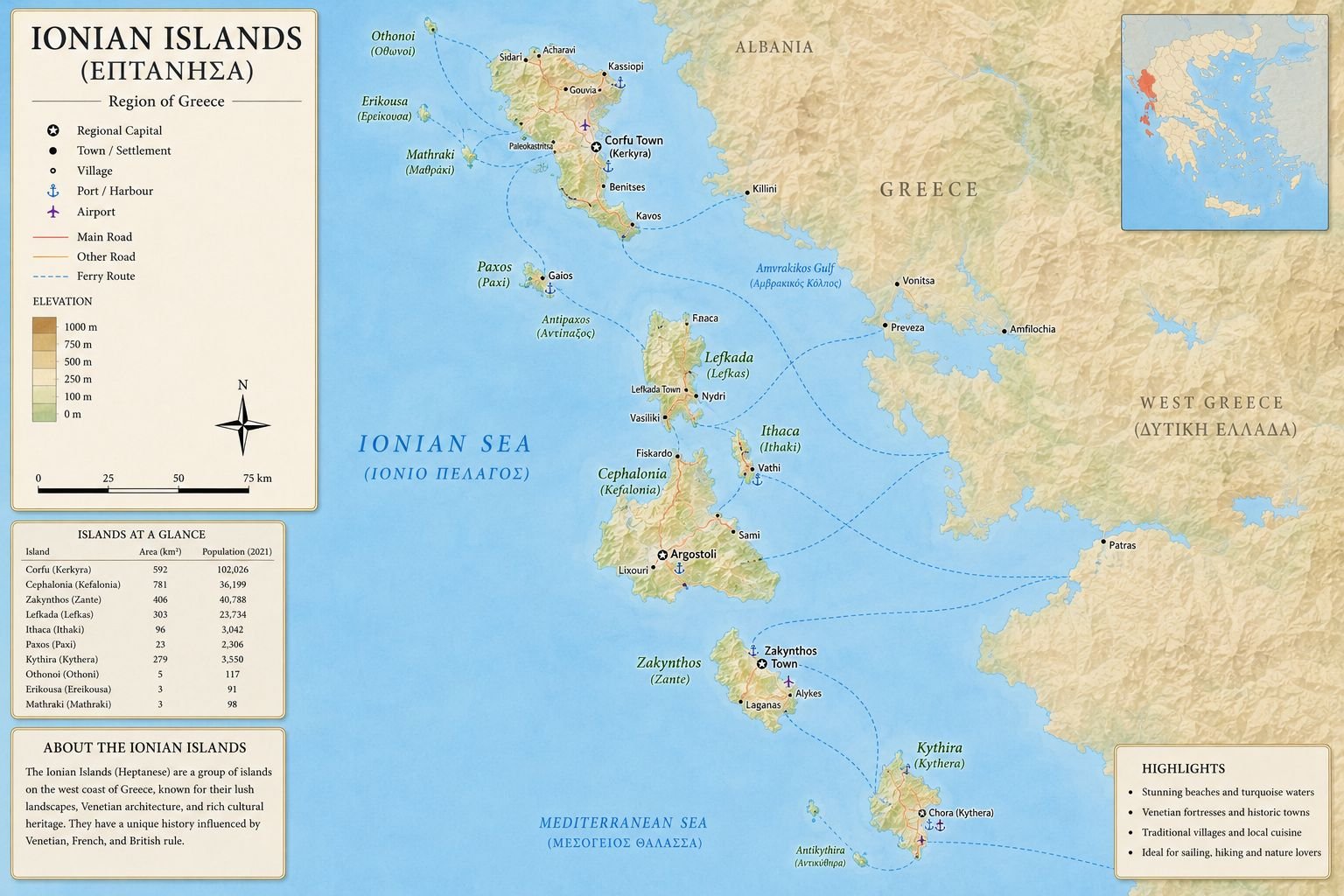
    Of all the Grecian archipelagos, the Ionian Islands are the most emerald, the most romantic, and arguably the most distinct. Stretched like a string of seven jewels down the western coast of Greece, this region – known in Greek as Eptánisa (The Seven Islands) – offers a travel experience far removed from the stark, sun-bleached drama of the Cyclades. Here, dramatic limestone cliffs plunge into turquoise waters, Venetian architecture lines marble-paved alleys, and the landscape is so lush with olive, cypress, and pine that Homer himself called it “the floating forest.”

    This is your complete guide to the Ionian Islands region: Corfu, Paxos, Lefkada, Ithaca, Kefalonia, Zakynthos, and Kythira.


    CORFU (Kerkyra): The Opulent Venetian Lady

    Corfu is the gateway to the Ionians, served by an international airport and a major ferry port. The island’s capital, also called Corfu Town, is a UNESCO World Heritage site – a living museum of Venetian, French, and British influences.

    • Must-See: The two imposing fortresses flanking the old town; the Liston arcade (a French-style café hub); the Palace of St. Michael and St. George; and Spianada Square, the largest square in Greece.
    • Natural Beauty: Paleokastritsa Monastery sits on a breathtaking bay of six coves. For a unique swim, head to Canal d’Amour (Channel of Love) in Sidari, where smooth sandstone channels create natural pools.
    • Tip: Rent a car to explore the interior villages like Pelekas, where Kaiser’s Throne offers a panoramic sunset over the entire island.

    PAXOS & ANTIPAXOS: The Quiet Aristocrats

    A short hydrofoil ride south of Corfu, Paxos is for those seeking serenity. It’s a low, olive-covered island with no airport, meaning crowds are minimal.

    • Must-See: The eerie, spectacular sea caves of Erimitis and the blue grottoes of Ortholithos. Take a day boat to Gaios, the main port, with its tiny islets (Panagia and Agios Nikolaos) guarding the harbor.
    • Antipaxos: A five-minute taxi-boat ride away, this tiny isle is famous for two things: its own wineries producing light red wine, and Voutoumi Beach – a crescent of white sand lapped by water so clear it looks like liquid sapphire.
    • Tip: Book a private boat tour from Gaios harbor. The captains know every hidden cove.

    LEFKADA: The Windsurfer’s Paradise

    Unlike its sisters, Lefkada is a former peninsula – a narrow drawbridge connects it to the mainland. This makes it easily accessible but no less spectacular. It’s the island of vertiginous cliffs and blinding white beaches.

    • Must-See: Porto Katsiki and Egremni – two of the most photographed beaches in the world. You descend hundreds of steps to reach sands backed by stark white chalk cliffs. For windsurfing, Vasiliki is a world-class mecca thanks to daily afternoon thermal winds.
    • Inland: Visit the Dimosari Waterfalls, a cold, refreshing plunge pool accessible via a short hike through a gorge.
    • Tip: Arrive at Porto Katsiki before 9:00 AM in July/August to secure parking and a sunbed. For a quieter alternative, try Kathisma Beach.

    ITHACA: The Legendary Homeland

    Ithaca is small, mountainous, and spiritually powerful – forever linked to Homer’s Odysseus. It has no airport and limited ferry service, which preserves its raw, authentic soul.

    • Must-See: The Archaeological Museum of Vathy (the island’s charming capital); the Cave of the Nymphs (where Odysseus supposedly hid the Phaeacians’ gifts); and the ruins of a Hellenistic triple-tiered cistern called Arethousa.
    • Walking: Ithaca is a hiker’s dream. The trail from Stavros to the School of Homer (a Mycenaean-era site) offers views over the channel to Kefalonia.
    • Tip: Don’t expect nightlife. Come here for swimming in secluded coves like Gidaki (accessible by boat or a steep 30-minute hike) and reading under olive trees.

    KEFALONIA: The Big, Bold Beauty

    The largest of the Ionians, Kefalonia is an island of massive scale – deep gorges, giant caves, and grand views. It was made famous by the novel and film Captain Corelli’s Mandolin.

    • Must-See: Melissani Cave Lake – a surreal, partially collapsed cavern where you float on a boat under a shaft of sunlight that turns the water electric blue. Then, nearby, Drogarati Cave with incredible acoustics (it’s used as a classical music venue). Finally, Myrtos Beach – a dramatic sweep of white pebbles between vertical karst mountains.
    • Fishing Villages: Fiscardo in the north survived the 1953 earthquake that rebuilt most of the island. Its pastel Venetian houses now host elegant yachts and fine seafood tavernas.
    • Tip: Drive across the island’s spine to the Ainos National Park, home to the endangered wild horse and endemic fir trees – it feels like the Alps above the sea.

    ZAKYNTHOS (Zante): The Marine Guardian

    Zakynthos is famous for two things: the most jaw-dropping shipwreck beach in the world, and its role as a nesting ground for the endangered loggerhead sea turtle (Caretta caretta).

    • Must-See: Navagio (Shipwreck) Beach. You can only see it from the viewing platform on the cliff (arrive early to beat bus tours) or arrive by boat – the rusty smuggler’s ship on blinding white sand is an unforgettable sight.
    • Conservation: The southern beaches of Laganas Bay, particularly Sekania and Marathonisi (Turtle Island), are protected zones. You can take legal turtle-spotting tours but must follow strict rules (no flash photography, maintain distance).
    • Blue Caves: On the northern tip, these vertical, sea-eroded grottos are best explored by small boat – the water inside glows deep cobalt.
    • Tip: The town of Zakynthos has a charming central square (Solomos Square) and a Venetian castle on the hill. For nightlife, Laganas is the party epicenter – avoid it if you seek peace.

    KYTHIRA: The Distant Cousin

    Set far to the south, almost midway between the Peloponnese and Crete, Kythira is often forgotten but beloved by those who find it. It’s fertile, windswept, and full of Byzantine castles and waterfalls that flow directly into the sea.

    • Must-See: The Venetian fortress of Chora (the capital), perched on a rocky headland, and the nearby Fonissa Waterfall – a multi-tiered cascade that ends in a freshwater swimming hole. Also, the cave at Agia Sofia with stalactites and ancient Christian frescoes.
    • Tip: Kythira’s airport is inconsistent; most visitors arrive by ferry from Neapoli (Peloponnese) or Antikythera. Rent a 4×4 – the roads to remote beaches like Fyri Ammos are rough.

    PRACTICAL TRAVEL INFORMATION

    Best Time to Visit: May-June and September-October are ideal. The sea is warm, the crowds are gone, and the sun is potent but not scorching. July-August is peak season – ferries book out, hotels double in price, and beaches are packed.

    Getting There & Around:

    • By Air: International airports on Corfu (CFU), Kefalonia (EFL), Zakynthos (ZTH), and Aktio (near Lefkada, PVK). Seasonal direct flights from most major European cities.
    • By Ferry: Regular car ferries connect the islands to each other and to the mainland ports of Igoumenitsa, Patras, and Kyllini. The “Ionian Islands” route makes a great island-hopping itinerary, though note that Kythira is on a separate southern loop.
    • On the Islands: Car or scooter rental is essential outside the main towns. Bus services exist but are infrequent and mostly for school routes.

    Food & Drink (What to Eat):

    • Bourdeto: A fiery, red spicy fish stew (a Venetian legacy).
    • Pastitsada: Corfu’s signature – rooster or veal cooked in a rich tomato sauce with cinnamon, cloves, and garlic, served over thick pasta.
    • Strapatsada: Scrambled eggs with fresh tomatoes, feta, and oregano – a perfect breakfast.
    • Mantoles: Almond brittle candies popular in Kefalonia.
    • Wine: Try the dry white Robola from Kefalonia’s mountain vineyards, or the sweet red Mavrodafne of Zakynthos.
    • Olive Oil: The Ionian forests produce some of Greece’s most buttery, mild extra virgin olive oil. Buy a tin.

    Cultural Etiquette & Tips:

    • Nudity: Officially illegal on all public beaches in Greece. Tolerated on isolated coves, but never near turtle nesting zones (rangers are active on Zakynthos).
    • Siesta: Between 15:00 and 17:00, many shops and some tavernas close. Use this time to nap or swim.
    • Caretta-Caretta: On Zakynthos, do not use white lights on the beach after dark (they disorient hatchlings). Use the red-filter setting on headlamps.
    • Earthquake Awareness: The Ionians are seismically active. Your accommodation will have a safety card – read it. That said, modern buildings are earthquake-resilient.

    SAMPLE 10-DAY ISLAND-HOPPING ITINERARY

    • Days 1-3: Fly into Corfu. Explore Corfu Town. Day trip to Paleokastritsa and Canal d’Amour.
    • Day 4: Morning hydrofoil to Paxos (1 hr). Overnight in Gaios. Swim at AntiPaxos.
    • Day 5: Hydrofoil to Lefkada (via Igoumenitsa, approx 3 hrs). Rent a car. Drive to Porto Katsiki for sunset.
    • Days 6-7: Drive to Vasiliki. Windsurf or hike to Dimosari Waterfalls. Early ferry to Kefalonia (Fiskardo).
    • Days 7-8: Kefalonia – Melissani Cave, Myrtos Beach, overnight in Fiskardo or Argostoli.
    • Day 9: Ferry to Zakynthos (2 hrs). View Navagio from the clifftop. Stay in the north for quiet, or town for history.
    • Day 10: Morning turtle-spotting tour in Laganas Bay. Fly out from Zakynthos (ZTH) via Athens or directly to a European hub.

    Note: Adding Ithaca or Kythira requires more time – save them for a second, slower trip.


    FINAL VERDICT

    The Ionian Islands region is not the Greece of whitewashed cubes and vivid blue domes. It is the Greece of wild rosemary on a hillside path, of a forgotten Venetian cannon overlooking an English-built road, of a sea so clear that your boat seems to float in air. It is softer, greener, and more emotional.

    Whether you come for the shipwreck of Zakynthos, the caves of Kefalonia, the windsurfing of Lefkada, or the quiet poetry of Ithaca, you will leave with salt in your hair and a promise to return. Because, as the local saying goes: “Once you drink the water of the Ionian, you will always hear it calling your name.”

    Safe travels – kaló taxídi.
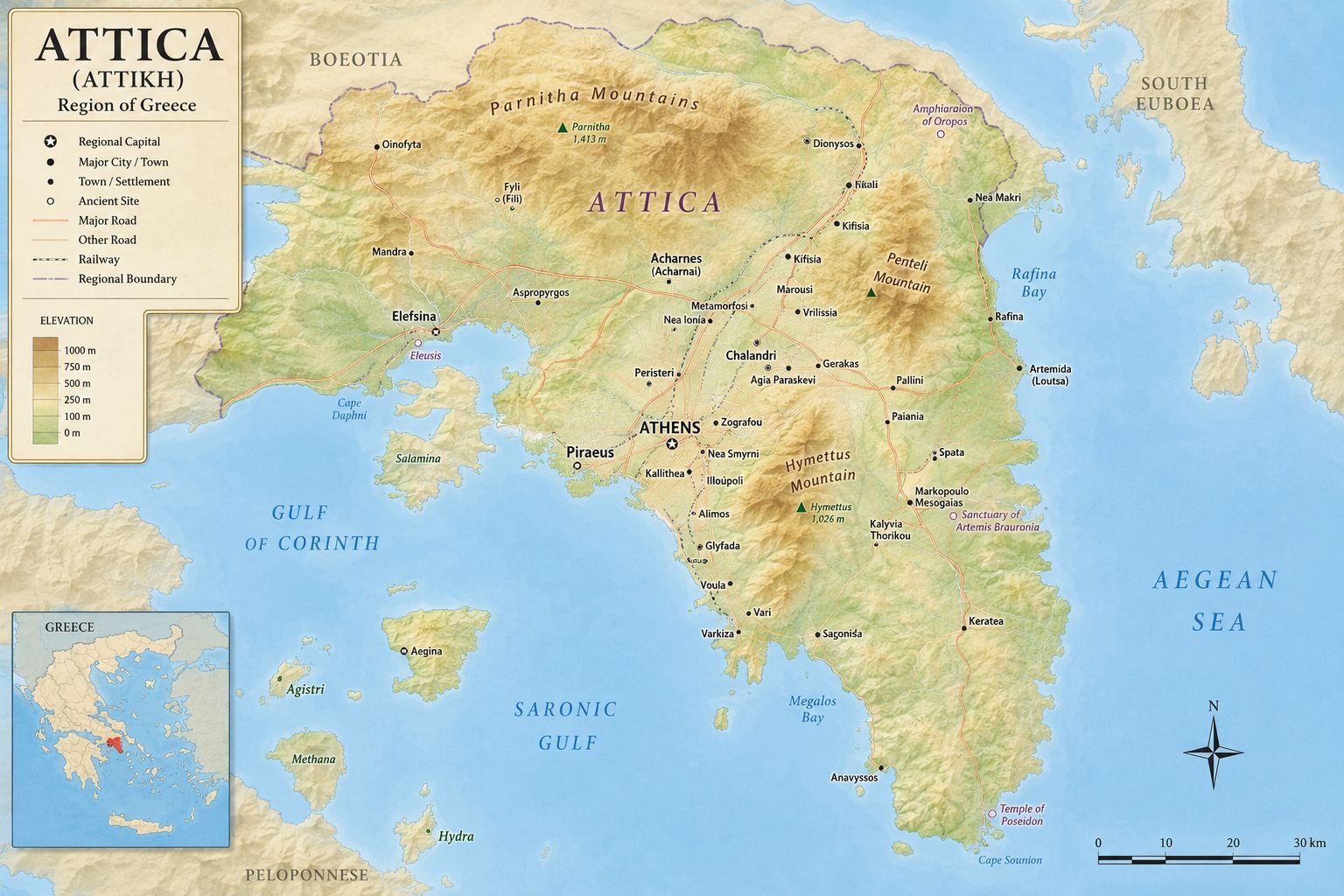
  • Attica is a premier administrative region of Greece

    Attica is a premier administrative region of Greece

    Attica is a premier administrative region of Greece encompassing the entire Athens metropolitan area, surrounding suburbs, and several Saronic Gulf islands. As the country’s most populous region and economic heart, it generates 48% of the national GDP. It features a mountainous, coastal landscape, including the Athens Riviera, and historic sites like the Acropolis and Cape Sounion.

    Key Details About Attica, Greece:
    Geography: A triangular peninsula in central Greece bounded by the Aegean Sea, featuring mountains like Parnitha (highest) and Hymettus, separating the plains of Pedias, Mesogeia, and Thriasian.
    Regional Units: The region is divided into eight units: Central Athens, Northern Athens, Southern Athens, Western Athens, Piraeus, Islands (Hydra, Spetses, Aegina, etc.), East Attica, and West Attica.
    Capital/Major Cities: Athens (capital) along with Piraeus (main port), Eleusis, Megara, and Marathon.
    Economy & Culture: Responsible for nearly half of Greece’s economic activity, the region is a hub for tourism, education, and culture, housing 17 universities and numerous museums.
    Governance: The region is governed by an elected regional governor, with Nikos Chardalias currently in office.

    Major Attractions & Landscape
    Archeological Sites: The Acropolis of Athens, Parthenon, Temple of Olympian Zeus, and Temple of Poseidon at Sounion.
    Nature & Coast: The Athens Riviera offers beaches and scenic views, while Parnitha National Park provides hiking and biodiversity.
    Islands: The “Islands” unit includes Hydra, Spetses, Aegina, Poros, Salamis, Angistri, Kythira, and Antikythera.
    Wine/Food: Attica is known for vineyards (especially around Mesogeia) and agricultural products like olive trees.

  • Regions of Greece

    Regions of Greece

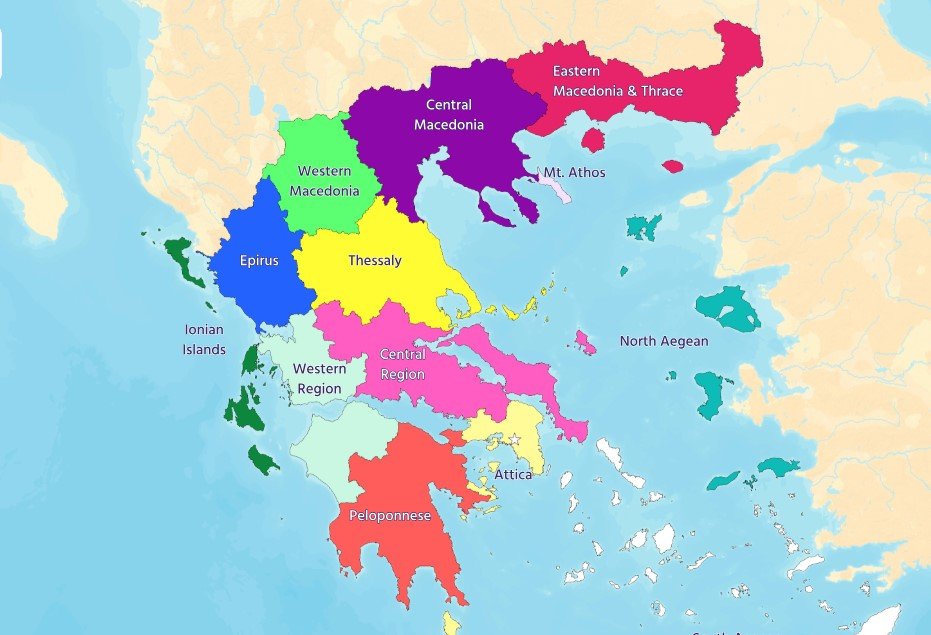
    Greece is divided into 13 administrative regions—further divided into 74 regional units—which serve as the main level of local government, alongside 7 decentralized administrations. Major regions include Attica (Athens), Central Macedonia (Thessaloniki), Crete, Peloponnese, and the Aegean/Ionian islands.

    The 13 Administrative Regions of Greece
    Attica: Includes the capital, Athens.
    Central Greece: The mainland region north of Attica.
    Central Macedonia: Features Thessaloniki and Mt. Athos.
    Crete: The largest and southernmost island.
    Eastern Macedonia and Thrace: Located in the northeast.
    Epirus: Mountainous region in the northwest.
    Ionian Islands: Located off the west coast.
    North Aegean: Island group in the northeast Aegean.
    Peloponnese: Peninsula in the south.
    South Aegean: Includes the Cyclades and Dodecanese island groups.
    Thessaly: Central region with plains and mountains.
    Western Greece: Coastal region on the Ionian Sea.
    Western Macedonia: Inland, mountainous region.

    Key Geographic Classifications
    Traditional Geographic Regions: Often divided into 9 areas: Macedonia, Central Greece, Peloponnese, Thessaly, Epirus, Aegean Islands, Thrace, Crete, and Ionian Islands.
    Administrative System: Since 2011, these 13 regions, combined with 7 decentralized administrations, manage local government.
    Climate & Geography: Coastal areas have mild, Mediterranean climates, while the interior is mountainous with harsher winters.

  • The Peloponnese is Greece’s Ultimate Destination

    The Peloponnese is Greece’s Ultimate Destination

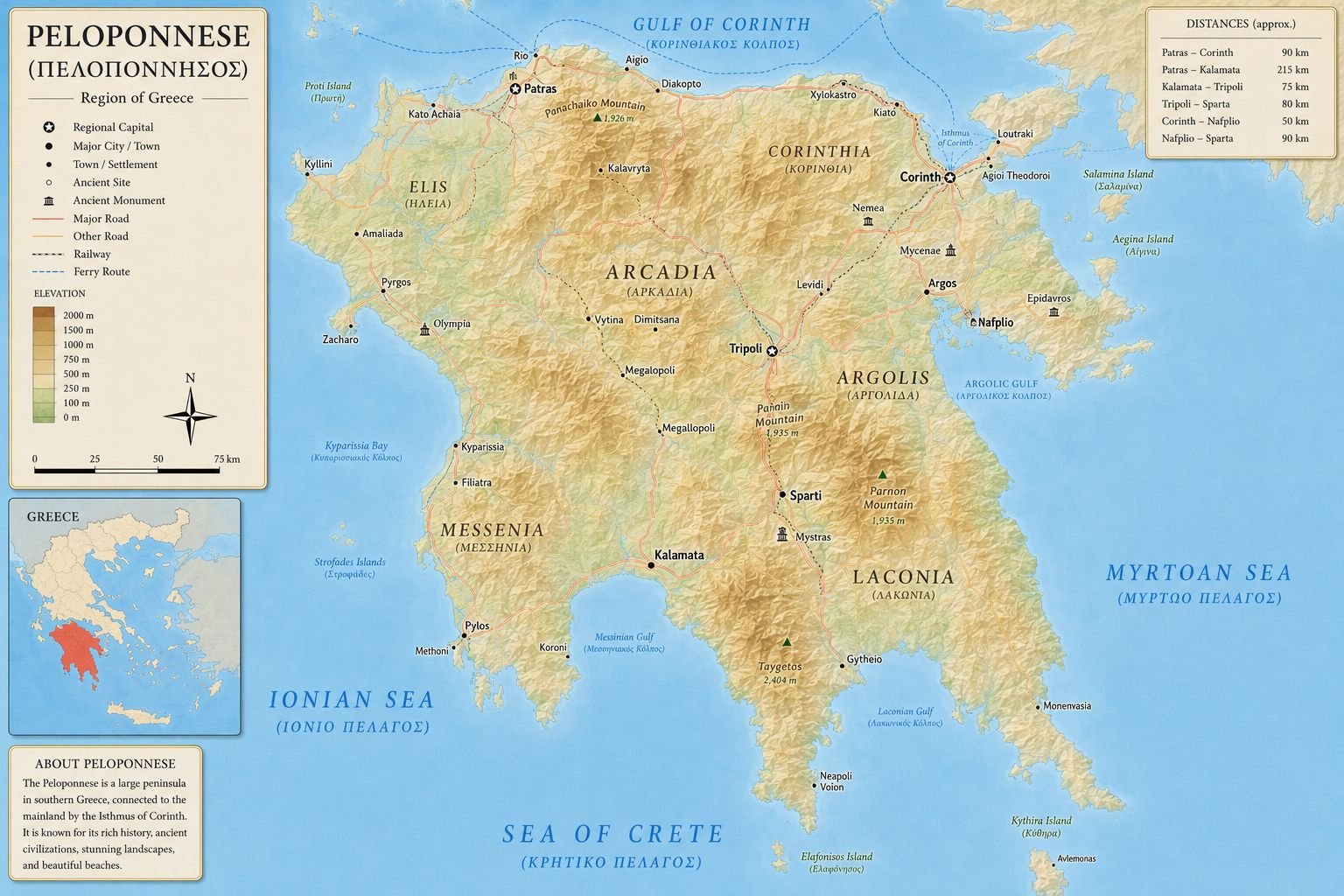
    Of all the regions in Greece, the Peloponnese is perhaps the most storied. Shaped like a giant plane tree leaf, connected to the mainland by the narrow Isthmus of Corinth, this peninsula is a living museum of myth, history, and raw natural beauty. A journey here is not just a vacation; it is a walk through the very foundations of Western civilization.

    Why the Peloponnese?
    Unlike the white-washed, Cycladic postcard image of Greek islands, the Peloponnese offers a wilder, more rugged, and deeply authentic experience. It is where Hercules performed his labors, where King Agamemnon ruled Mycenae, where the Spartans forged their warrior culture, and where the first Olympic Games were held. Today, it offers a perfect blend: ancient ruins with fewer crowds than Athens, dramatic mountain ranges, stunning coastlines, and some of the finest food and wine in Greece.

    Getting There and Around
    The region is easily accessible. You can drive from Athens across the Corinth Canal (a breathtaking 24-meter-wide man-made chasm) in just over an hour. Alternatively, the Kiato-Patras railway offers scenic routes, and KTEL buses connect all major towns. However, to truly explore the hidden coves, mountain villages, and archaeological sites, renting a car is essential. Roads are generally good, though mountain passes can be winding.

    The Main Regions & Must-See Destinations

    1. The Northeast: Corinthia and Argolis – The Epicenter of Ancient Glory
    Start your journey here. Just across the canal, the Ancient Corinth was a wealthy Roman-era city. Walk the same paved road where the Apostle Paul preached to the Corinthians. Above it towers Acrocorinth, a massive fortress offering dizzying views.

    An hour south lies the Unesco-listed Mycenae. Enter through the famous Lion Gate, the oldest monumental sculpture in Europe. See the beehive tombs, including the so-called “Treasury of Atreus,” and the golden mask of Agamemnon (now in the Athens National Museum, but its spirit lingers here).

    Nearby, the seaside town of Nafplio is arguably the most beautiful in Greece. Once the first capital of the modern Greek state, it’s a romantic maze of Venetian architecture, neoclassical mansions, and harborfront cafes. Climb the 999 steps to the Palamidi Fortress for a panoramic sunset, or take a water taxi to the tiny Bourtzi castle in the bay.

    2. The South: Laconia and Mani – Spartan Soul and Tower Forts
    Venture deeper to Sparta. Modern Sparta is a quiet town, but the ancient city left little above ground – the Spartans preferred deeds over monuments. Visit the sanctuary of Artemis Orthia and the well-preserved Roman-era Museum of the Olive and Greek Olive Oil, a fitting tribute to the region’s lifeblood.

    From Sparta, the Mani Peninsula unfolds – a harsh, desolate, and breathtakingly beautiful land. Its villages are guarded by distinctive stone tower houses, built for clan feuds. Areopoli and Gerolimenas are atmospheric bases. Drive to the very tip to Cape Tainaron, the ancient entrance to the Underworld (Hades). There is a small temple to Poseidon and a plunging view into the cobalt sea.

    3. The West: Messinia and Olympia – Birthplace of the Games
    The west coast is softer, with sandy beaches and vast olive groves. The Unesco site of Ancient Olympia is, of course, unmissable. Stand on the original stadium’s starting line, run at the gymnasium, and see the workshop of Phidias, who crafted the giant gold-and-ivory statue of Zeus, one of the seven wonders of the ancient world.

    Just south, the modern region of Messinia boasts Pylos and the astonishing Palace of Nestor, the best-preserved Mycenaean palace in Greece. Nearby, the fortress town of Methoni offers a photogenic sea castle, and the beach at Voidokilia is shaped like a perfect Greek omega (Ω) – a crescent of white sand hugging a turquoise lagoon.

    4. The Center: Arcadia – Mountain Villages and Cool Air
    Escape the summer heat in the mountainous heartland. Dimitsana and Stemnitsa are postcard-perfect stone villages with cobbled lanes and traditional tavernas. Visit the Open-Air Water Power Museum to see pre-industrial grain mills and tanneries. The Lousios Gorge, a dramatic rift cut by the river, is excellent for hiking and home to cliff-hanging monasteries like the Philosophou Monastery.

    Activities and Experiences

    • Hiking: The Menalon Trail is a marked, 75 km path connecting Arcadian villages, perfect for multi-day treks.
    • Wine Tasting: The Nemea region produces Agiorgitiko, a soft, velvety red wine. Visit family-run wineries in the vineyards between Corinth and Argos.
    • Beach Life: For family-friendly sand, go to Tolo or Skafidia. For dramatic pebble coves, the Mani coast (Foneas, Delfinia) is stunning.
    • Olive Oil Tour: The Peloponnese produces 70% of Greece’s extra virgin olive oil. Many organic farms offer tastings – look for the black, briny Kalamata olive as a snack.

    Food to Savor
    Food here is rustic and honest. Do not leave without trying:

    • Goges/Syglino (Mani): Pasta with pork or a smoky cured pork product.
    • Lalagia (Corinth): Fried dough strips, usually for breakfast with honey or cheese.
    • Diples (everywhere): Thin fried dough rolls dipped in honey and walnuts.
    • Fresh seafood in coastal villages like Kardamili or Kalamata (the city known for its olives, but also a vibrant port).

    Practical Tips

    • Best time to go: April to June and September to October. Summers (July-August) are very hot, especially at archaeological sites. Spring offers wildflowers; autumn offers harvest festivals.
    • What to pack: Sturdy walking shoes (ruined floors are uneven), a hat, sunscreen, and swimwear. In spring/fall, a light jacket for mountain evenings.
    • Budget: Generally cheaper than the Cyclades islands. Mid-range taverna meal: €12-18 per person. Entry to major sites: €6-12, with combined tickets available.
    • Etiquette: When visiting monasteries (e.g., in Lousios Gorge), cover shoulders and knees. Always greet shopkeepers with “Kalimera” (good morning) and “Efharisto” (thank you).

    The Peloponnese is not a place to tick boxes. It is a region to absorb. You will leave with dust on your boots, the taste of olive oil on your tongue, and a profound sense that its ancient stories are still whispering from the stones. Whether you are a history lover, a hiker, a beachcomber, or a gourmand, this peninsula will call you back again and again.

  • Central Greece: Where Myth Meets Mountain & Sea

    Central Greece: Where Myth Meets Mountain & Sea

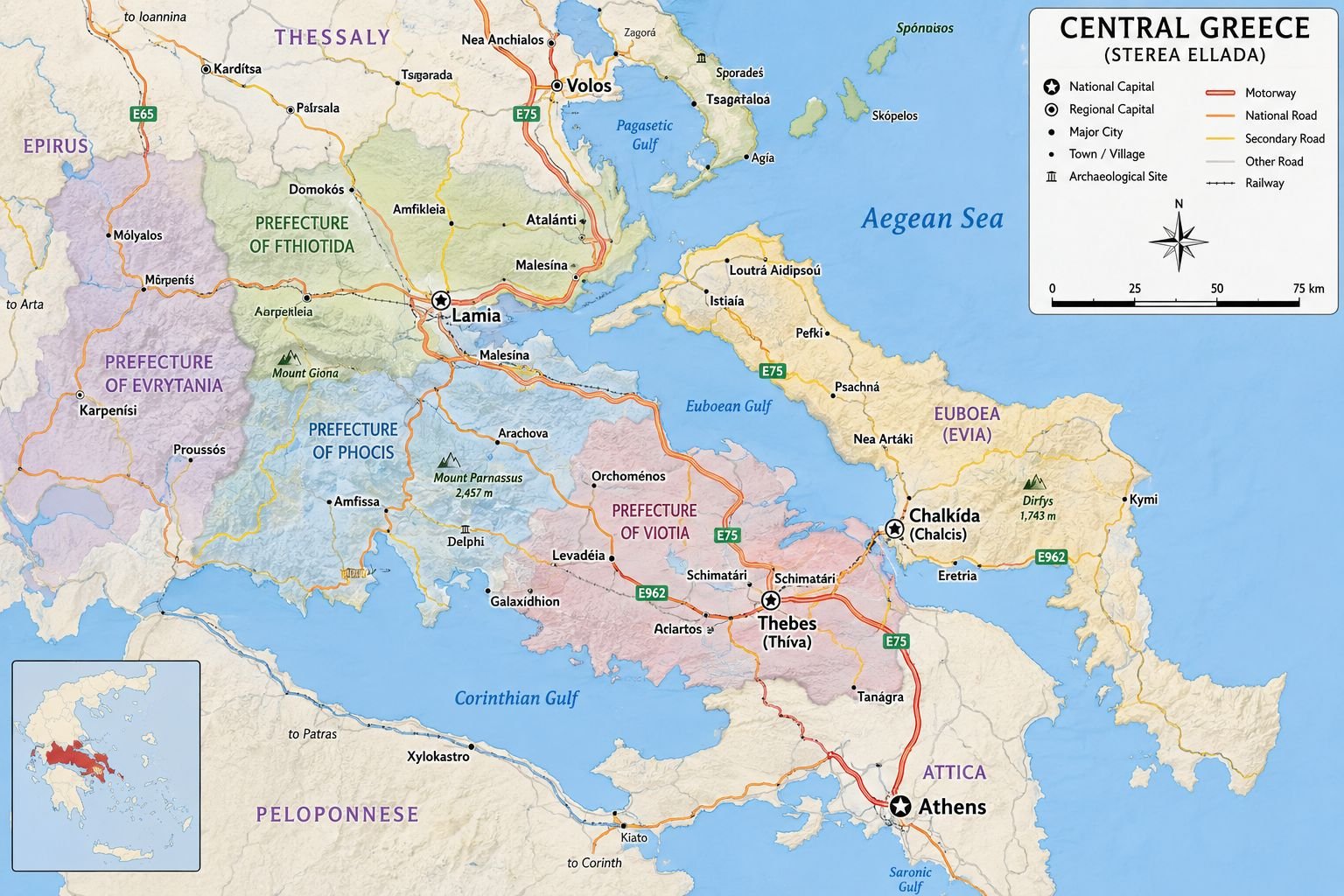
    When travelers dream of Greece, they picture the white-washed buildings of Santorini, the party streets of Mykonos, or the ancient ruins of the Peloponnese. But tucked between the iconic city of Athens and the dramatic cliffs of Meteora lies a landscape that many miss: Central Greece, known locally as Sterea Ellada. This region is the mainland’s rugged heart, a place of mountain monasteries, chilling battlefields, pristine ski slopes, and thermal springs. It is a destination for those who want to taste authentic, unpolished Greece.

    This article covers the administrative region of Central Greece, including the regional units of Evrytania, Phthiotis, Phocis, Boeotia, and Euboea (the second-largest Greek island).

    1. The Crown Jewel: Delphi (Phocis)
      No trip to Central Greece is complete without the ancient sanctuary of Delphi. Nestled on the slopes of Mount Parnassus, the Greeks considered this the “navel of the world.”
      What to see: The Sanctuary of Apollo, where the Oracle spoke her riddles; the ancient Theatre with breathtaking views; the Athenian Treasury; and the Delphi Archaeological Museum, home to the bronze Charioteer.
      Tip: Arrive early in the morning or late in the afternoon to avoid the tour buses from Athens. The site is steep, so wear sturdy shoes.
    2. The Mountains: Mount Parnassus & Arachova (Phocis/Boeotia)
      Just a 20-minute drive from Delphi is Arachova, a cosmopolitan winter village known for its black-and-white stonework, thick rugs (flokati), and red wine.
      Winter sports: Mount Parnassus is Greece’s largest ski center. With 25 lifts and runs for all levels, it operates from December to April.
      Food: Try “formaela” (grilled cheese) and “barbouti” (local pasta) in the stone-built tavernas of Arachova.
    3. The Monastery & The Rock: Hosios Loukas (Boeotia)
      Often overshadowed by Meteora, the Byzantine monastery of Hosios Loukas is a UNESCO World Heritage site and a masterpiece of Middle Byzantine architecture. Located near the town of Distomo, the monastery is famous for its stunning gold-ground mosaics and frescoes. The crypt is particularly moving, dedicated to the hermit Venerable Luke (Hosios Loukas). Combine this with a visit to the nearby “skete” (hermit caves).
    4. The Heroic Pass: Thermopylae (Phthiotis)
      History buffs will recognize the “Hot Gates.” Today, Thermopylae is a flat, coastal plain, but the famous narrow pass has been filled in by centuries of silt. A modern bronze statue of King Leonidas greets visitors alongside a hilltop monument that reads: “Go tell the Spartans, stranger passing by, that here, obedient to their laws, we lie.”
      What to do: Visit the small visitor center, see the replica of the ancient Phocian Wall, and soak in the nearby natural thermal springs (which give the pass its name).
    5. The Island of Evia (Euboea)
      Connected to the mainland by two long bridges (at Chalkida), Evia is a world of its own.
      North Evia: Famous for the dramatic waterfalls of Drymonas and the petrified forest of Kerasia. The town of Edipsos is one of Europe’s oldest spa towns, with hot springs that have been flowing since ancient times. Aristotle once described them.
      South Evia: Wild and rugged, with the impressive Dimosari Gorge and the unique rock formation of “Kyra” (Our Lady) in Karystos. This is a paradise for hikers and geologists.
    6. The Lake That Dances: Lake Kremasta (Evrytania)
      One of the largest artificial lakes in Europe, Lake Kremasta borders Evrytania and Aetolia-Acarnania. It is famous for the “Dancing Forest” – a forest of drowned trees whose tips still poke above the water, creating an eerie, beautiful landscape.
      Activities: Boating, freshwater fishing, and visiting the village of Kefalovryso. The town of Karpenisi (the capital of Evrytania) is a hub for mountain adventure: rafting on the Tavropos River, mountain biking at Velouchi, and hiking to the Korishades Waterfalls.
    7. The Byzantine Gem: Thebes (Boeotia)
      Once a rival to ancient Athens (and the city of Oedipus), modern Thebes is primarily an industrial city, but it holds a rich archaeological story. The Archaeological Museum of Thebes is one of the best in Greece, displaying incredible Mycenaean treasures, including cylinder seals and wall paintings. Don’t miss the “Kadmeia” (the ancient citadel) and the remnants of the Mycenaean palace.

    Practical Travel Tips for Central Greece

    Best Time to Visit: Spring (April-June) and Autumn (September-October). The mountains are green, the snow has melted (except on Parnassus), and the archaeological sites are not scorching hot. Winter is for skiing; summer is for the Evia coastline and high mountain villages (which are cooler than the islands).

    Getting Around: You absolutely need a rental car. Public buses (KTEL) connect major towns like Lamia, Chalkida, and Amfissa, but they do not reach the remote villages, waterfalls, or gorges. Roads in the mountains are winding but paved.

    Food & Drink:

    • Formaela cheese (smoked, from Arachova).
    • Souvla (spit-roasted lamb or goat), especially on Sundays.
    • Gigandes (giant baked beans) in the plains of Boeotia.
    • Retsina wine from Chalkida (pine-flavored white wine).
    • Local honey and walnuts from Evrytania.

    Accommodation:

    • Luxury: Stay in a converted stone manor in Arachova (e.g., Lykovrisi).
    • Rustic: Rent a cabin in Karpenisi near the river.
    • Budget: Use the cities of Lamia or Livadeia as hubs for day trips.

    Sample 7-Day Itinerary:
    Day 1: Arrive at Athens Airport. Drive to Arachova (2 hours). Sunset in Arachova.
    Day 2: Morning at Delphi. Afternoon at Hosios Loukas monastery. Overnight in Livadeia.
    Day 3: Drive to Thermopylae (1 hour). Quick stop. Continue to Karpenisi (2 hours) via the scenic mountains.
    Day 4: Explore Lake Kremasta and the waterfalls of Evrytania. Rafting in the afternoon.
    Day 5: Drive to Evia via the bridge at Chalkida (3 hours). Afternoon at Edipsos thermal springs.
    Day 6: Explore North Evia: Drymonas Falls and the petrified forest.
    Day 7: Drive back to Athens via the mainland coast. Stop at the ancient city of Orchomenos (Boeotia) for a final dose of ruins.

    Why Central Greece?
    Because this is the Greece that time forgot and nature reclaimed. It is the Greece of shepherds and scholars, of snowy peaks and smoking hot springs. It lacks the polish of the islands, but what it offers is depth—geological, historical, and cultural. If you want to stand where Spartan kings once stood, hike through forests that inspired ancient myths, and eat dinner in a village square where no one speaks English but everyone offers you wine, then look beyond the Aegean. Central Greece is waiting.