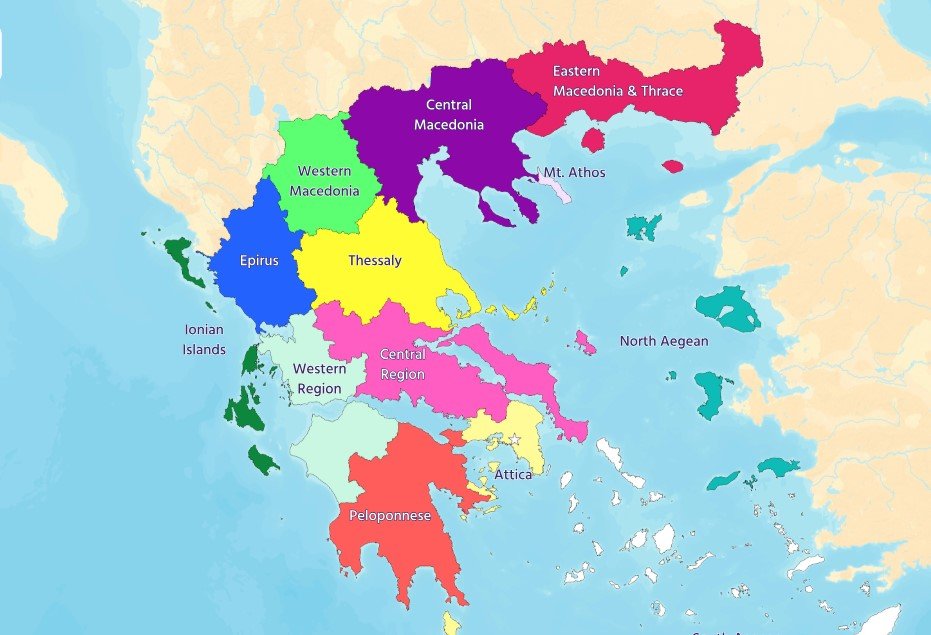
Greece is divided into 13 administrative regions—further divided into 74 regional units—which serve as the main level of local government, alongside 7 decentralized administrations. Major regions include Attica (Athens), Central Macedonia (Thessaloniki), Crete, Peloponnese, and the Aegean/Ionian islands.
The 13 Administrative Regions of Greece
Attica: Includes the capital, Athens.
Central Greece: The mainland region north of Attica.
Central Macedonia: Features Thessaloniki and Mt. Athos.
Crete: The largest and southernmost island.
Eastern Macedonia and Thrace: Located in the northeast.
Epirus: Mountainous region in the northwest.
Ionian Islands: Located off the west coast.
North Aegean: Island group in the northeast Aegean.
Peloponnese: Peninsula in the south.
South Aegean: Includes the Cyclades and Dodecanese island groups.
Thessaly: Central region with plains and mountains.
Western Greece: Coastal region on the Ionian Sea.
Western Macedonia: Inland, mountainous region.
Key Geographic Classifications
Traditional Geographic Regions: Often divided into 9 areas: Macedonia, Central Greece, Peloponnese, Thessaly, Epirus, Aegean Islands, Thrace, Crete, and Ionian Islands.
Administrative System: Since 2011, these 13 regions, combined with 7 decentralized administrations, manage local government.
Climate & Geography: Coastal areas have mild, Mediterranean climates, while the interior is mountainous with harsher winters.
Leave a Reply