Author: Ti

  • Zakynthos Island, Greece: Where Nature Paints in Blue and Gold

    Zakynthos Island, Greece: Where Nature Paints in Blue and Gold

    Zakynthos, commonly referred to as Zante, is a beautiful Greek island located in the Ionian Sea, renowned for its breathtaking turquoise waters, dramatic cliffs, and world-famous shipwreck beach. As the third-largest Ionian island, Zakynthos offers a perfect blend of natural beauty, vibrant nightlife, rich history, and family-friendly resorts. Whether you are an adventure seeker, a nature lover, or a culture enthusiast, Zakynthos delivers an unforgettable Mediterranean escape.

    GEOGRAPHY & CLIMATE

    • Location: Ionian Sea, west of mainland Greece. 16 km south of Kefalonia.
    • Area: Approximately 406 square kilometers.
    • Coastline: 123 kilometers of rugged cliffs and sandy coves.
    • Capital: Zakynthos Town (Chora), on the eastern coast.
    • Climate: Typical Mediterranean – hot, dry summers (June–August: 25-35°C) and mild, wet winters (December–February: 10-15°C). Best travel months: May to early October.

    TOP ATTRACTIONS & MUST-SEE SITES

    1. NAVAGIO BEACH (SHIPWRECK BEACH)

    The most photographed beach in Greece. A rusty smuggler’s ship (MV Panagiotis) rests on pristine white sand, enclosed by towering limestone cliffs and electric-blue water. Accessible only by boat from the ports of Agios Nikolaos, Skinari, or Zakynthos Town. Pro tip: Visit early morning or late afternoon to avoid crowds. No shade or facilities – bring water and sun protection.

    2. BLUE CAVES (NEAR CAPE SKINARI)

    A natural wonder of dazzling azure reflections. Take a glass-bottom boat tour to explore arches, tunnels, and caves. Daredevils can swim through the “Kianoun Cave” passage. Best visibility around midday.

    3. MARATHONISI ISLAND (TURTLE ISLAND)

    A protected islet shaped like a turtle (hence the name). Two stunning sandy bays connected by a narrow strip of land. A key nesting area for loggerhead sea turtles (Caretta caretta). Snorkeling gear essential – shallow warm waters teem with marine life.

    4. KERI CAVES & MIZITHRES PENINSULA

    Dramatic white cliffs plunging into deep cobalt sea. Take a boat trip from Keri Harbor to enter sea caves (some with small waterfalls). The lighthouse atop Mizithres offers spectacular sunset views.

    5. BANANA BEACH & LAGANAS BAY

    Banana Beach: The longest sandy beach on the island. Lively, with water sports, beach bars, and sunbeds. Laganas Bay: A protected marine park where turtles nest. Boat tours offer turtle-spotting (keep respectful distance).

    6. ZAKYNTHOS TOWN (CHORA)

    Venetian-influenced architecture. Rebuilt after the 1953 earthquake.

    • Solomos Square (central hub with cafes and the Byzantine Museum).
    • St. Dionysios Church (patron saint of the island, houses his remains).
    • Bohali Hill (Venetian castle ruins and panoramic sunset views).

    BEST BEACHES FOR EVERY TRAVELER

    Beach NameVibeBest ForAccess
    NavagioDramatic, iconicPhotography, adventureBoat only
    Porto LimnionasRocky, naturalCliff jumping, snorkelingRoad + stairs
    Porto RoxaQuiet, pebblyRelaxation, solitudeDirt road
    GerakasFamily-friendly, sandTurtle nesting, shallow waterRoad + walk
    DafniSemi-organizedTurtles, calm watersRoad
    XigiaSulfur springsTherapeutic swimming, uniqueRoad + stairs

    ACTIVITIES & EXPERIENCES

    • Boat Tours: The only way to reach Navagio and Blue Caves. Half-day trips (€25-40) depart from multiple ports.
    • Sea Turtle Spotting: Guided eco-tours from Laganas. Respect nesting zones (May–October).
    • Scuba Diving & Snorkeling: Top sites – Marathonisi Caves, Keri Caves, and the “HMS Perseus” submarine wreck.
    • Hiking: Trails through the inland mountains (e.g., Vrachionas range). Maps available at tourist offices.
    • Water Sports: Banana, parasailing, jet ski, wakeboard at Banana Beach.
    • Local Cuisine Experiences: Olive oil tastings, winery visits (local white wine – Verdea), and cooking classes.

    WHERE TO STAY: AREAS & ACCOMMODATION

    A. LAGANAS – PARTY CENTRAL

    • Vibe: Non-stop nightlife, bars, clubs, loud music.
    • Best for: Young adults, groups aged 18-30.
    • Accommodation: Budget hotels, hostels, self-catering studios.

    B. TSILIVI – BALANCED CHOICE

    • Vibe: Lively but family-friendly. Beach bars, restaurants, water sports.
    • Best for: Couples, families with teens.
    • Accommodation: Mid-range hotels, beachfront apartments.

    C. ARGASSI – TRADITIONAL & RELAXED

    • Vibe: Quieter than Laganas, Greek tavernas, souvenir shops.
    • Best for: Older couples, families with young kids.
    • Accommodation: Boutique hotels, villas with pools.

    D. AGIOS NIKOLAOS (NORTH) – SCENIC & RUSTIC

    • Vibe: Small fishing village, stunning sea views, authentic.
    • Best for: Hikers, nature lovers, tranquility seekers.
    • Accommodation: Traditional guesthouses, villas.

    E. ZAKYNTHOS TOWN – CULTURAL HUB

    • Vibe: Urban, shops, museums, ferry connections.
    • Best for: Culture buffs, day-trip base without a car.
    • Accommodation: City hotels, B&Bs.

    FOOD & DRINK – MUST-TRY LOCAL SPECIALTIES

    • Sofrito: Veal slow-cooked in white wine, garlic, and parsley sauce.
    • Rabbit Stew (Stifado): With pearl onions and red wine.
    • Ladotyri: Hard, spicy cheese aged in olive oil.
    • Froutalia: Traditional omelet with potatoes and local sausage.
    • Mandolato: Nougat with honey, almonds, and egg whites (Patron’s sweet).
    • Fouskakia: Sweet fried dough balls with cinnamon and honey.
    • Local Drinks: Ouzo, Kumquat liqueur, Verdea wine (protected origin).

    PRACTICAL INFORMATION

    GETTING THERE

    • By Air: Zakynthos International Airport “Dionysios Solomos” (ZTH). Direct flights from many European cities (April–October). Year-round from Athens.
    • By Ferry: From Kyllini (mainland Peloponnese) – 1 hour. Also ferries from Kefalonia and Italy (seasonal).

    GETTING AROUND

    • Car Rental (recommended): €30-50/day. Essential for remote beaches and mountains.
    • Quad/ATV Rental: Popular but less safe on winding roads.
    • Bus (KTEL): Limited routes between major resorts and Zakynthos Town.
    • Taxis: Available but expensive. Agree on fare before departure.
    • Boat Taxis: For beach access (e.g., from Agios Nikolaos to Navagio).

    ESSENTIAL TIPS

    • Sun Protection: High UV index. Use SPF 50+ and a hat.
    • Water Shoes: Many beaches are pebbly or rocky.
    • Respect Turtle Zones: Do not place umbrellas on marked nesting areas. No lights or loud noises at night on nesting beaches.
    • Mosquito Repellent: Required in summer evenings.
    • Cash: Small tavernas and boat operators may not accept cards.
    • Peak Season (July–August): Expect crowds and higher prices. Book ferries and tours 2–3 days in advance.

    TYPICAL COSTS (2025 estimates)

    • Budget daily (hostel + street food): €40-60
    • Mid-range (hotel + taverna meals): €90-140
    • Luxury (villa + fine dining): €200+

    SAMPLE ITINERARIES

    3-DAY QUICK GETAWAY

    Day 1: Arrive Zakynthos Town → Explore Solomos Square, Bohali Castle sunset.
    Day 2: Boat tour to Navagio & Blue Caves → Afternoon at Porto Limnionas.
    Day 3: Morning at Gerakas Beach (turtles) → Afternoon departure.

    5-DAY FAMILY ADVENTURE

    Day 1: Tsilivi – settle in, beach time.
    Day 2: Marathonisi boat trip (turtle spotting + swim).
    Day 3: Water sports at Banana Beach → Evening traditional taverna.
    Day 4: Day trip to Keri Caves & Mizithres lighthouse.
    Day 5: Xigia sulfur springs → Departure.

    7-DAY EXPLORER

    Day 1-2: North – Agios Nikolaos, Blue Caves (swim inside), hiking.
    Day 3-4: West coast – Porto Roxa, Askos Stone Park (zoo + nature).
    Day 5-6: South – Laganas marine park, Gerakas, Cameo Island.
    Day 7: Zakynthos Town museums + last-minute shopping.

    Zakynthos is more than a postcard-perfect island – it is a living postcard with soul. From the jaw-dropping Navagio Beach to the gentle loggerhead turtles gliding through Laganas Bay, the island offers moments of pure magic. Respect its fragile ecosystems, embrace the slow Greek pace, and you will leave with a heart full of Ionian blue.
    Enjoy your journey – or as the Greeks say,
    “Kalo taxidi!”
  • Attica is a premier administrative region of Greece

    Attica is a premier administrative region of Greece

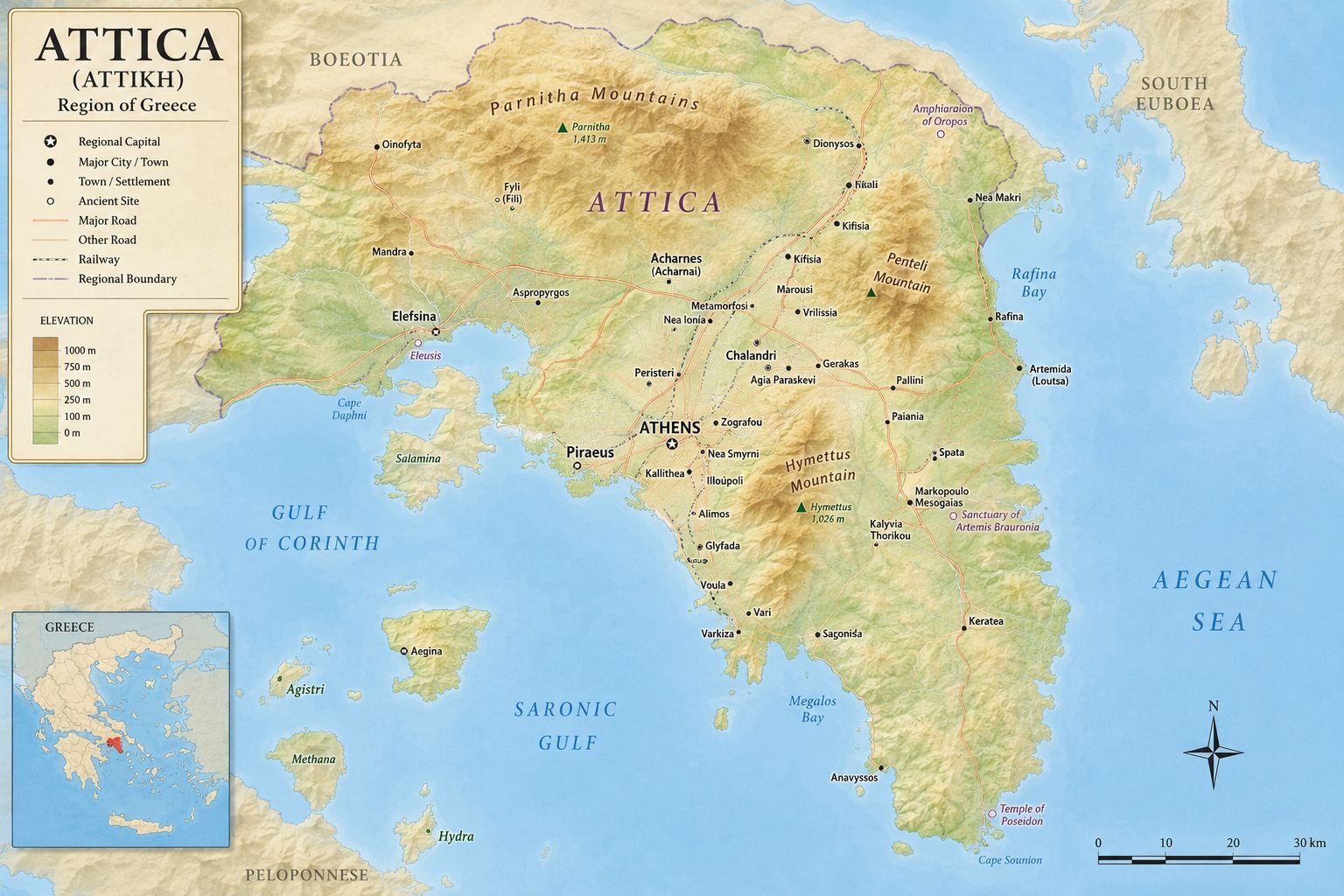
    Attica is a premier administrative region of Greece encompassing the entire Athens metropolitan area, surrounding suburbs, and several Saronic Gulf islands. As the country’s most populous region and economic heart, it generates 48% of the national GDP. It features a mountainous, coastal landscape, including the Athens Riviera, and historic sites like the Acropolis and Cape Sounion.

    Key Details About Attica, Greece:
    Geography: A triangular peninsula in central Greece bounded by the Aegean Sea, featuring mountains like Parnitha (highest) and Hymettus, separating the plains of Pedias, Mesogeia, and Thriasian.
    Regional Units: The region is divided into eight units: Central Athens, Northern Athens, Southern Athens, Western Athens, Piraeus, Islands (Hydra, Spetses, Aegina, etc.), East Attica, and West Attica.
    Capital/Major Cities: Athens (capital) along with Piraeus (main port), Eleusis, Megara, and Marathon.
    Economy & Culture: Responsible for nearly half of Greece’s economic activity, the region is a hub for tourism, education, and culture, housing 17 universities and numerous museums.
    Governance: The region is governed by an elected regional governor, with Nikos Chardalias currently in office.

    Major Attractions & Landscape
    Archeological Sites: The Acropolis of Athens, Parthenon, Temple of Olympian Zeus, and Temple of Poseidon at Sounion.
    Nature & Coast: The Athens Riviera offers beaches and scenic views, while Parnitha National Park provides hiking and biodiversity.
    Islands: The “Islands” unit includes Hydra, Spetses, Aegina, Poros, Salamis, Angistri, Kythira, and Antikythera.
    Wine/Food: Attica is known for vineyards (especially around Mesogeia) and agricultural products like olive trees.

  • Regions of Greece

    Regions of Greece

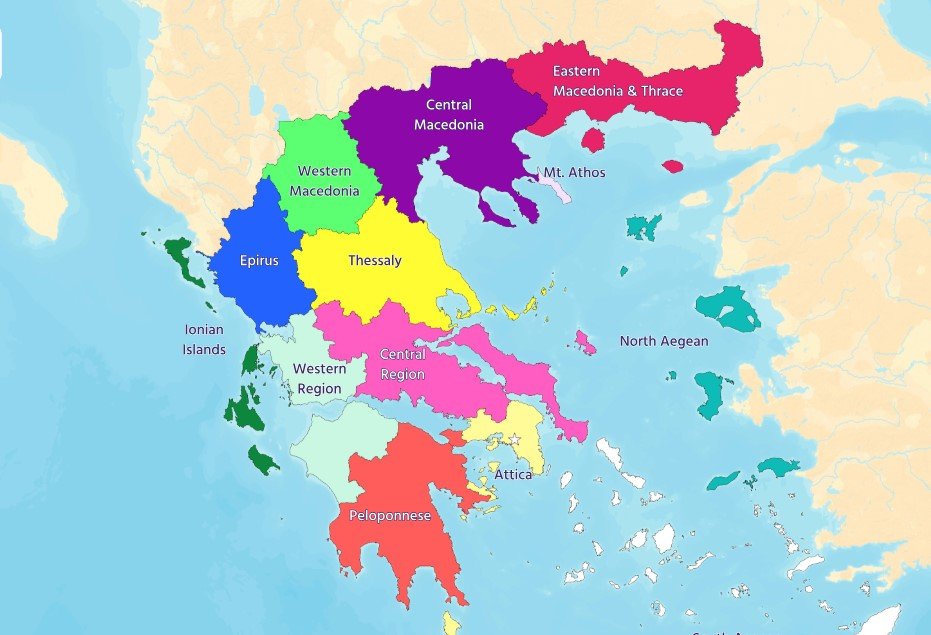
    Greece is divided into 13 administrative regions—further divided into 74 regional units—which serve as the main level of local government, alongside 7 decentralized administrations. Major regions include Attica (Athens), Central Macedonia (Thessaloniki), Crete, Peloponnese, and the Aegean/Ionian islands.

    The 13 Administrative Regions of Greece
    Attica: Includes the capital, Athens.
    Central Greece: The mainland region north of Attica.
    Central Macedonia: Features Thessaloniki and Mt. Athos.
    Crete: The largest and southernmost island.
    Eastern Macedonia and Thrace: Located in the northeast.
    Epirus: Mountainous region in the northwest.
    Ionian Islands: Located off the west coast.
    North Aegean: Island group in the northeast Aegean.
    Peloponnese: Peninsula in the south.
    South Aegean: Includes the Cyclades and Dodecanese island groups.
    Thessaly: Central region with plains and mountains.
    Western Greece: Coastal region on the Ionian Sea.
    Western Macedonia: Inland, mountainous region.

    Key Geographic Classifications
    Traditional Geographic Regions: Often divided into 9 areas: Macedonia, Central Greece, Peloponnese, Thessaly, Epirus, Aegean Islands, Thrace, Crete, and Ionian Islands.
    Administrative System: Since 2011, these 13 regions, combined with 7 decentralized administrations, manage local government.
    Climate & Geography: Coastal areas have mild, Mediterranean climates, while the interior is mountainous with harsher winters.

  • Greece’s Most Visited Towns and Holiday Destinations

    Greece is a country where ancient history, spectacular landscapes, island charm, and Mediterranean culture come together. From glamorous island resorts and whitewashed villages to historic mainland cities and picturesque coastal towns, Greece offers an extraordinary variety of destinations for every type of traveller.

    The country’s most popular places include world-famous destinations such as Athens, Santorini, Mykonos, Rhodes, and Corfu, attracting millions of visitors each year with their unique combination of history, natural beauty, beaches, gastronomy, and vibrant local life.

    Beyond these iconic locations, Greece is filled with charming towns and villages that showcase the country’s diverse character. Below are some of the most visited and memorable destinations across the Greek islands and mainland.

    Cyclades Islands

    The Cyclades are famous for their iconic whitewashed houses, blue-domed churches, dramatic coastlines, and unforgettable sunsets.

    Fira, Santorini

    The lively capital of Santorini, Fira offers breathtaking views over the volcanic caldera, traditional architecture, boutique shops, restaurants, and spectacular sea views.

    Oia, Santorini

    One of Greece’s most photographed villages, Oia is world-renowned for its romantic sunsets, charming narrow streets, luxury hotels, and stunning views of the Aegean Sea.

    Mykonos Town (Chora), Mykonos

    A glamorous island destination known for its cosmopolitan atmosphere, elegant restaurants, lively nightlife, famous windmills, and beautiful waterfront area of Little Venice.

    Naxos Town (Chora), Naxos

    Combining traditional island life with beautiful beaches, Naxos Town features a Venetian castle, historic streets, and a relaxed seaside atmosphere.

    Naoussa, Paros

    A picturesque fishing village transformed into one of the Cyclades’ most stylish destinations, Naoussa is known for its charming harbour, seafood restaurants, and elegant nightlife.

    Parikia, Paros

    The main port of Paros offers traditional whitewashed alleys, historic churches, waterfront cafés, and easy access to the island’s beaches.

    Adamantas and Plaka, Milos

    Milos is famous for its volcanic landscapes and extraordinary beaches. Adamantas is the island’s main harbour, while Plaka offers traditional charm and panoramic sunset views.

    Ermoupolis, Syros

    The elegant capital of Syros is celebrated for its impressive neoclassical buildings, grand squares, cultural events, and the historic Apollo Theatre.

    Chora, Ios

    A popular destination among younger travellers, Ios combines beautiful beaches, lively nightlife, and a charming hilltop village filled with traditional churches.

    Chora, Amorgos

    A beautifully preserved Cycladic village located on a mountain slope, Chora offers authentic island atmosphere, stone houses, and spectacular views.


    Ionian Islands

    The Ionian Islands are known for their lush landscapes, turquoise waters, Venetian influences, and elegant coastal towns.

    Corfu Town (Kerkyra)

    A UNESCO-listed historic city, Corfu Town features Venetian architecture, impressive fortresses, elegant squares, and a rich blend of Greek, French, and British influences.

    Zakynthos Town

    The island’s capital combines a historic harbour, traditional squares, colourful architecture, and a lively dining scene.

    Argostoli and Fiskardo, Kefalonia

    Argostoli offers a vibrant waterfront and cultural attractions, while Fiskardo is a charming harbour village famous for its colourful buildings and scenic setting.

    Lefkada Town

    Serving as the gateway to some of Greece’s most beautiful beaches, Lefkada Town combines island charm with a lively marina atmosphere.

    Gaios, Paxos

    A small but enchanting waterfront village, Gaios is known for its picturesque harbour, traditional houses, and peaceful island lifestyle.


    Dodecanese Islands

    Located in the southeastern Aegean, the Dodecanese Islands combine medieval heritage, ancient ruins, and beautiful seaside landscapes.

    Rhodes Town

    One of Greece’s greatest historic treasures, Rhodes Town is famous for its medieval Old Town, impressive city walls, and the magnificent Palace of the Grand Master.

    Lindos, Rhodes

    A postcard-perfect village featuring whitewashed houses, narrow streets, and the ancient Acropolis of Lindos overlooking the sea.

    Kos Town

    A lively destination blending ancient history, cycling paths, beaches, and nightlife, with highlights including the ancient Asklepieion sanctuary.

    Patmos Town (Skala)

    A spiritual and historic destination known for the Monastery of Saint John and its connection to early Christian history.

    Symi Town

    Famous for its colourful neoclassical mansions, beautiful harbour, and traditional island atmosphere, Symi is one of the most scenic ports in Greece.


    Crete

    Greece’s largest island offers a fascinating mix of ancient civilizations, dramatic scenery, beaches, and authentic villages.

    Chania

    A favourite among visitors, Chania features a beautiful Venetian harbour, historic lighthouse, colourful old town, and atmospheric narrow streets.

    Rethymno

    Known for its well-preserved old town, Venetian architecture, and impressive fortress, Rethymno combines history with a relaxed seaside atmosphere.

    Heraklion

    The capital of Crete and the island’s main gateway, Heraklion is home to important museums and provides access to the legendary Palace of Knossos.

    Agios Nikolaos

    A stylish coastal town famous for Lake Voulismeni, waterfront restaurants, and its elegant holiday atmosphere.

    Chersonissos

    A popular resort area offering beaches, entertainment, nightlife, and a wide range of accommodation options.


    Mainland Greece and the Peloponnese

    Beyond the islands, mainland Greece offers ancient wonders, mountain landscapes, historic towns, and authentic Greek experiences.

    Thessaloniki

    Greece’s second-largest city and culinary capital, Thessaloniki is famous for the White Tower, Byzantine heritage, vibrant markets, and exceptional food culture.

    Nafplio

    One of the most beautiful towns in the Peloponnese, Nafplio features Venetian architecture, charming streets, seaside promenades, and historic castles.

    Kalabaka (Meteora)

    Located beneath the spectacular rock formations of Meteora, Kalabaka is the gateway to the famous cliff-top monasteries, a UNESCO World Heritage Site.

    Delphi

    A historic village near the ancient sanctuary of Delphi, once considered the centre of the ancient Greek world.

    Ioannina

    A scenic lakeside city surrounded by mountains, known for its Ottoman heritage, island on Lake Pamvotis, and rich cultural traditions.

    Parga

    A colourful coastal town with Venetian influences, beautiful beaches, a hilltop castle, and a picturesque waterfront.

    Monemvasia

    A medieval fortress town built on a massive sea rock, offering stone streets, historic churches, and unforgettable views of the Aegean.

    Galaxidi

    A peaceful seaside village with traditional architecture, old mansions, and a charming harbour atmosphere.

    Olympia

    The birthplace of the ancient Olympic Games, Olympia attracts visitors interested in archaeology, mythology, and Greek history.

    Kavala

    A beautiful coastal city featuring a historic aqueduct, Ottoman monuments, a scenic harbour, and panoramic views across the Aegean.

    Discover the Diversity of Greece

    Whether you are searching for romantic sunsets in Santorini, nightlife in Mykonos, ancient history in Athens and Delphi, medieval charm in Rhodes, or peaceful coastal villages away from the crowds, Greece offers endless opportunities for exploration.

    Each town has its own identity, traditions, and stories, making Greece one of the world’s most rewarding travel destinations.

  • The Peloponnese is Greece’s Ultimate Destination

    The Peloponnese is Greece’s Ultimate Destination

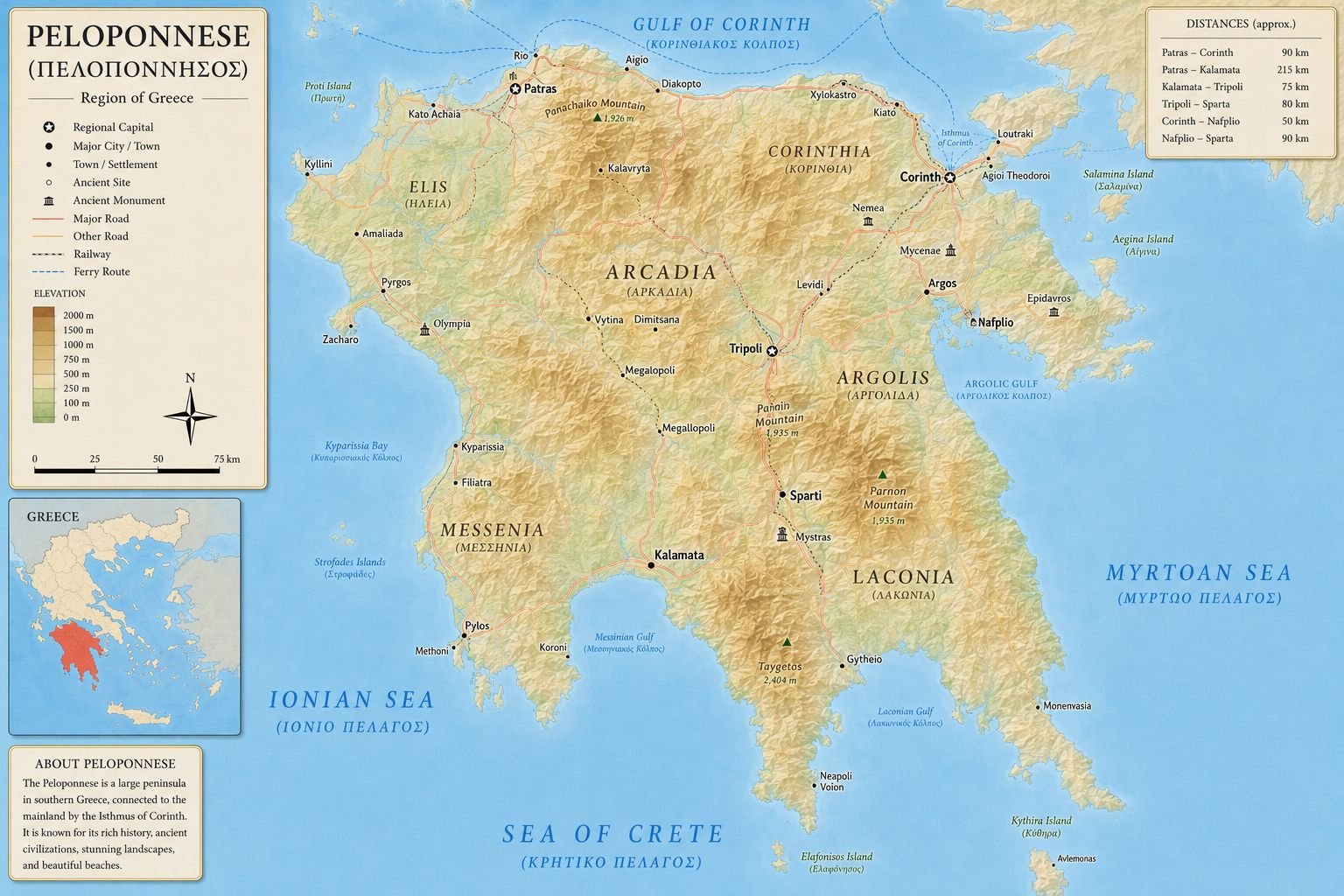
    Of all the regions in Greece, the Peloponnese is perhaps the most storied. Shaped like a giant plane tree leaf, connected to the mainland by the narrow Isthmus of Corinth, this peninsula is a living museum of myth, history, and raw natural beauty. A journey here is not just a vacation; it is a walk through the very foundations of Western civilization.

    Why the Peloponnese?
    Unlike the white-washed, Cycladic postcard image of Greek islands, the Peloponnese offers a wilder, more rugged, and deeply authentic experience. It is where Hercules performed his labors, where King Agamemnon ruled Mycenae, where the Spartans forged their warrior culture, and where the first Olympic Games were held. Today, it offers a perfect blend: ancient ruins with fewer crowds than Athens, dramatic mountain ranges, stunning coastlines, and some of the finest food and wine in Greece.

    Getting There and Around
    The region is easily accessible. You can drive from Athens across the Corinth Canal (a breathtaking 24-meter-wide man-made chasm) in just over an hour. Alternatively, the Kiato-Patras railway offers scenic routes, and KTEL buses connect all major towns. However, to truly explore the hidden coves, mountain villages, and archaeological sites, renting a car is essential. Roads are generally good, though mountain passes can be winding.

    The Main Regions & Must-See Destinations

    1. The Northeast: Corinthia and Argolis – The Epicenter of Ancient Glory
    Start your journey here. Just across the canal, the Ancient Corinth was a wealthy Roman-era city. Walk the same paved road where the Apostle Paul preached to the Corinthians. Above it towers Acrocorinth, a massive fortress offering dizzying views.

    An hour south lies the Unesco-listed Mycenae. Enter through the famous Lion Gate, the oldest monumental sculpture in Europe. See the beehive tombs, including the so-called “Treasury of Atreus,” and the golden mask of Agamemnon (now in the Athens National Museum, but its spirit lingers here).

    Nearby, the seaside town of Nafplio is arguably the most beautiful in Greece. Once the first capital of the modern Greek state, it’s a romantic maze of Venetian architecture, neoclassical mansions, and harborfront cafes. Climb the 999 steps to the Palamidi Fortress for a panoramic sunset, or take a water taxi to the tiny Bourtzi castle in the bay.

    2. The South: Laconia and Mani – Spartan Soul and Tower Forts
    Venture deeper to Sparta. Modern Sparta is a quiet town, but the ancient city left little above ground – the Spartans preferred deeds over monuments. Visit the sanctuary of Artemis Orthia and the well-preserved Roman-era Museum of the Olive and Greek Olive Oil, a fitting tribute to the region’s lifeblood.

    From Sparta, the Mani Peninsula unfolds – a harsh, desolate, and breathtakingly beautiful land. Its villages are guarded by distinctive stone tower houses, built for clan feuds. Areopoli and Gerolimenas are atmospheric bases. Drive to the very tip to Cape Tainaron, the ancient entrance to the Underworld (Hades). There is a small temple to Poseidon and a plunging view into the cobalt sea.

    3. The West: Messinia and Olympia – Birthplace of the Games
    The west coast is softer, with sandy beaches and vast olive groves. The Unesco site of Ancient Olympia is, of course, unmissable. Stand on the original stadium’s starting line, run at the gymnasium, and see the workshop of Phidias, who crafted the giant gold-and-ivory statue of Zeus, one of the seven wonders of the ancient world.

    Just south, the modern region of Messinia boasts Pylos and the astonishing Palace of Nestor, the best-preserved Mycenaean palace in Greece. Nearby, the fortress town of Methoni offers a photogenic sea castle, and the beach at Voidokilia is shaped like a perfect Greek omega (Ω) – a crescent of white sand hugging a turquoise lagoon.

    4. The Center: Arcadia – Mountain Villages and Cool Air
    Escape the summer heat in the mountainous heartland. Dimitsana and Stemnitsa are postcard-perfect stone villages with cobbled lanes and traditional tavernas. Visit the Open-Air Water Power Museum to see pre-industrial grain mills and tanneries. The Lousios Gorge, a dramatic rift cut by the river, is excellent for hiking and home to cliff-hanging monasteries like the Philosophou Monastery.

    Activities and Experiences

    • Hiking: The Menalon Trail is a marked, 75 km path connecting Arcadian villages, perfect for multi-day treks.
    • Wine Tasting: The Nemea region produces Agiorgitiko, a soft, velvety red wine. Visit family-run wineries in the vineyards between Corinth and Argos.
    • Beach Life: For family-friendly sand, go to Tolo or Skafidia. For dramatic pebble coves, the Mani coast (Foneas, Delfinia) is stunning.
    • Olive Oil Tour: The Peloponnese produces 70% of Greece’s extra virgin olive oil. Many organic farms offer tastings – look for the black, briny Kalamata olive as a snack.

    Food to Savor
    Food here is rustic and honest. Do not leave without trying:

    • Goges/Syglino (Mani): Pasta with pork or a smoky cured pork product.
    • Lalagia (Corinth): Fried dough strips, usually for breakfast with honey or cheese.
    • Diples (everywhere): Thin fried dough rolls dipped in honey and walnuts.
    • Fresh seafood in coastal villages like Kardamili or Kalamata (the city known for its olives, but also a vibrant port).

    Practical Tips

    • Best time to go: April to June and September to October. Summers (July-August) are very hot, especially at archaeological sites. Spring offers wildflowers; autumn offers harvest festivals.
    • What to pack: Sturdy walking shoes (ruined floors are uneven), a hat, sunscreen, and swimwear. In spring/fall, a light jacket for mountain evenings.
    • Budget: Generally cheaper than the Cyclades islands. Mid-range taverna meal: €12-18 per person. Entry to major sites: €6-12, with combined tickets available.
    • Etiquette: When visiting monasteries (e.g., in Lousios Gorge), cover shoulders and knees. Always greet shopkeepers with “Kalimera” (good morning) and “Efharisto” (thank you).

    The Peloponnese is not a place to tick boxes. It is a region to absorb. You will leave with dust on your boots, the taste of olive oil on your tongue, and a profound sense that its ancient stories are still whispering from the stones. Whether you are a history lover, a hiker, a beachcomber, or a gourmand, this peninsula will call you back again and again.