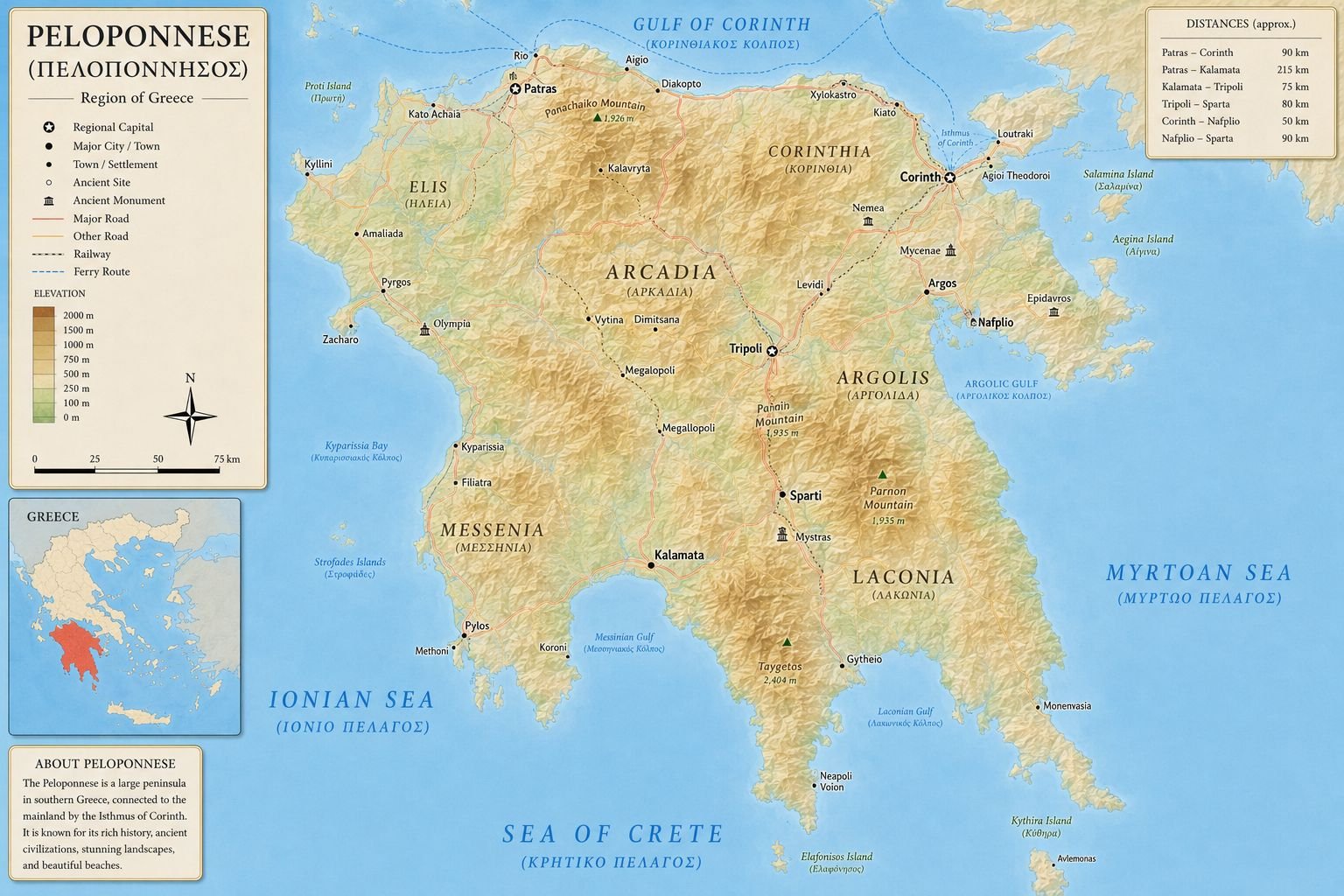
Of all the regions in Greece, the Peloponnese is perhaps the most storied. Shaped like a giant plane tree leaf, connected to the mainland by the narrow Isthmus of Corinth, this peninsula is a living museum of myth, history, and raw natural beauty. A journey here is not just a vacation; it is a walk through the very foundations of Western civilization.
Why the Peloponnese?
Unlike the white-washed, Cycladic postcard image of Greek islands, the Peloponnese offers a wilder, more rugged, and deeply authentic experience. It is where Hercules performed his labors, where King Agamemnon ruled Mycenae, where the Spartans forged their warrior culture, and where the first Olympic Games were held. Today, it offers a perfect blend: ancient ruins with fewer crowds than Athens, dramatic mountain ranges, stunning coastlines, and some of the finest food and wine in Greece.
Getting There and Around
The region is easily accessible. You can drive from Athens across the Corinth Canal (a breathtaking 24-meter-wide man-made chasm) in just over an hour. Alternatively, the Kiato-Patras railway offers scenic routes, and KTEL buses connect all major towns. However, to truly explore the hidden coves, mountain villages, and archaeological sites, renting a car is essential. Roads are generally good, though mountain passes can be winding.
The Main Regions & Must-See Destinations
1. The Northeast: Corinthia and Argolis – The Epicenter of Ancient Glory
Start your journey here. Just across the canal, the Ancient Corinth was a wealthy Roman-era city. Walk the same paved road where the Apostle Paul preached to the Corinthians. Above it towers Acrocorinth, a massive fortress offering dizzying views.
An hour south lies the Unesco-listed Mycenae. Enter through the famous Lion Gate, the oldest monumental sculpture in Europe. See the beehive tombs, including the so-called “Treasury of Atreus,” and the golden mask of Agamemnon (now in the Athens National Museum, but its spirit lingers here).
Nearby, the seaside town of Nafplio is arguably the most beautiful in Greece. Once the first capital of the modern Greek state, it’s a romantic maze of Venetian architecture, neoclassical mansions, and harborfront cafes. Climb the 999 steps to the Palamidi Fortress for a panoramic sunset, or take a water taxi to the tiny Bourtzi castle in the bay.
2. The South: Laconia and Mani – Spartan Soul and Tower Forts
Venture deeper to Sparta. Modern Sparta is a quiet town, but the ancient city left little above ground – the Spartans preferred deeds over monuments. Visit the sanctuary of Artemis Orthia and the well-preserved Roman-era Museum of the Olive and Greek Olive Oil, a fitting tribute to the region’s lifeblood.
From Sparta, the Mani Peninsula unfolds – a harsh, desolate, and breathtakingly beautiful land. Its villages are guarded by distinctive stone tower houses, built for clan feuds. Areopoli and Gerolimenas are atmospheric bases. Drive to the very tip to Cape Tainaron, the ancient entrance to the Underworld (Hades). There is a small temple to Poseidon and a plunging view into the cobalt sea.
3. The West: Messinia and Olympia – Birthplace of the Games
The west coast is softer, with sandy beaches and vast olive groves. The Unesco site of Ancient Olympia is, of course, unmissable. Stand on the original stadium’s starting line, run at the gymnasium, and see the workshop of Phidias, who crafted the giant gold-and-ivory statue of Zeus, one of the seven wonders of the ancient world.
Just south, the modern region of Messinia boasts Pylos and the astonishing Palace of Nestor, the best-preserved Mycenaean palace in Greece. Nearby, the fortress town of Methoni offers a photogenic sea castle, and the beach at Voidokilia is shaped like a perfect Greek omega (Ω) – a crescent of white sand hugging a turquoise lagoon.
4. The Center: Arcadia – Mountain Villages and Cool Air
Escape the summer heat in the mountainous heartland. Dimitsana and Stemnitsa are postcard-perfect stone villages with cobbled lanes and traditional tavernas. Visit the Open-Air Water Power Museum to see pre-industrial grain mills and tanneries. The Lousios Gorge, a dramatic rift cut by the river, is excellent for hiking and home to cliff-hanging monasteries like the Philosophou Monastery.
Activities and Experiences
- Hiking: The Menalon Trail is a marked, 75 km path connecting Arcadian villages, perfect for multi-day treks.
- Wine Tasting: The Nemea region produces Agiorgitiko, a soft, velvety red wine. Visit family-run wineries in the vineyards between Corinth and Argos.
- Beach Life: For family-friendly sand, go to Tolo or Skafidia. For dramatic pebble coves, the Mani coast (Foneas, Delfinia) is stunning.
- Olive Oil Tour: The Peloponnese produces 70% of Greece’s extra virgin olive oil. Many organic farms offer tastings – look for the black, briny Kalamata olive as a snack.
Food to Savor
Food here is rustic and honest. Do not leave without trying:
- Goges/Syglino (Mani): Pasta with pork or a smoky cured pork product.
- Lalagia (Corinth): Fried dough strips, usually for breakfast with honey or cheese.
- Diples (everywhere): Thin fried dough rolls dipped in honey and walnuts.
- Fresh seafood in coastal villages like Kardamili or Kalamata (the city known for its olives, but also a vibrant port).
Practical Tips
- Best time to go: April to June and September to October. Summers (July-August) are very hot, especially at archaeological sites. Spring offers wildflowers; autumn offers harvest festivals.
- What to pack: Sturdy walking shoes (ruined floors are uneven), a hat, sunscreen, and swimwear. In spring/fall, a light jacket for mountain evenings.
- Budget: Generally cheaper than the Cyclades islands. Mid-range taverna meal: €12-18 per person. Entry to major sites: €6-12, with combined tickets available.
- Etiquette: When visiting monasteries (e.g., in Lousios Gorge), cover shoulders and knees. Always greet shopkeepers with “Kalimera” (good morning) and “Efharisto” (thank you).
The Peloponnese is not a place to tick boxes. It is a region to absorb. You will leave with dust on your boots, the taste of olive oil on your tongue, and a profound sense that its ancient stories are still whispering from the stones. Whether you are a history lover, a hiker, a beachcomber, or a gourmand, this peninsula will call you back again and again.