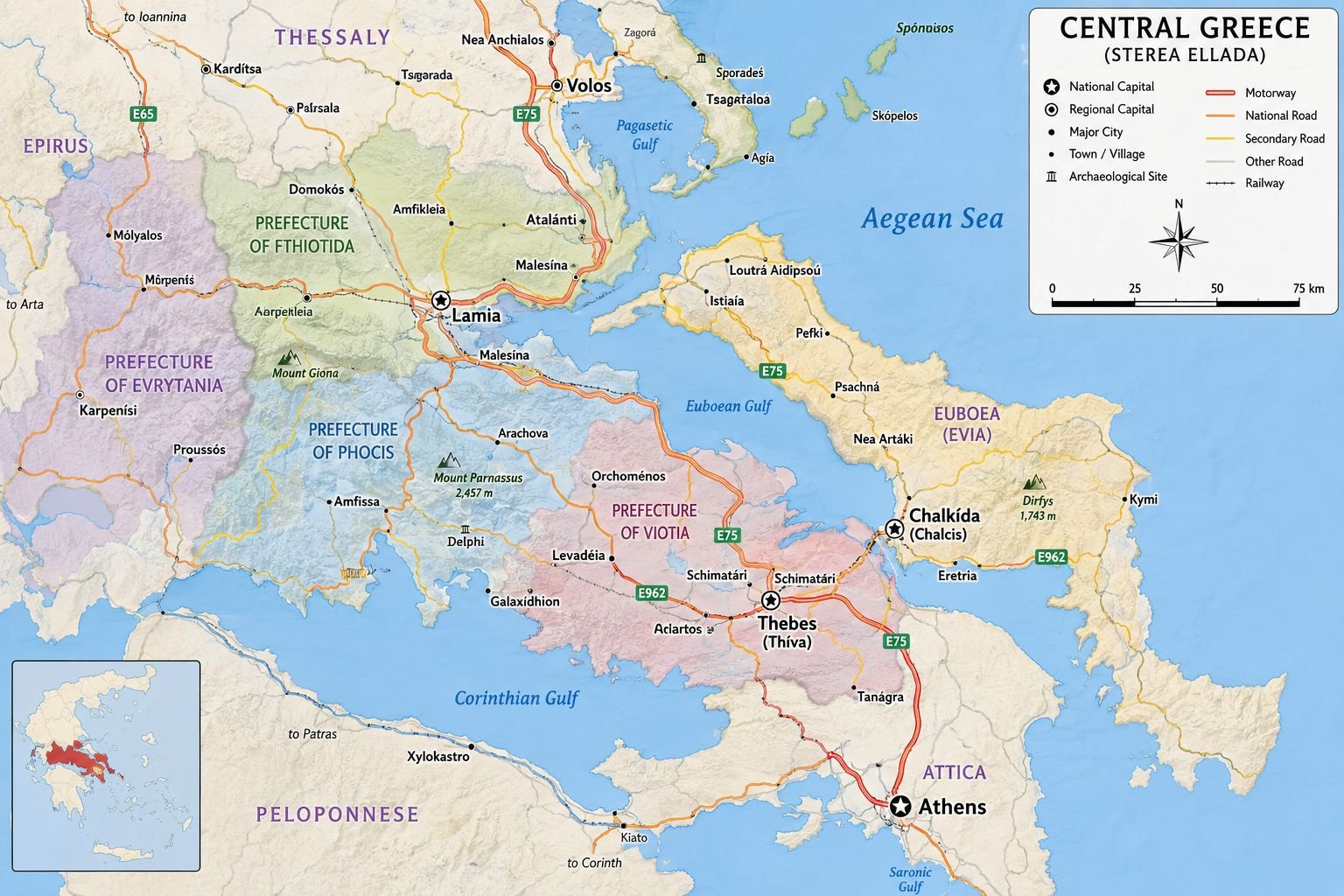
When travelers dream of Greece, they picture the white-washed buildings of Santorini, the party streets of Mykonos, or the ancient ruins of the Peloponnese. But tucked between the iconic city of Athens and the dramatic cliffs of Meteora lies a landscape that many miss: Central Greece, known locally as Sterea Ellada. This region is the mainland’s rugged heart, a place of mountain monasteries, chilling battlefields, pristine ski slopes, and thermal springs. It is a destination for those who want to taste authentic, unpolished Greece.
This article covers the administrative region of Central Greece, including the regional units of Evrytania, Phthiotis, Phocis, Boeotia, and Euboea (the second-largest Greek island).
- The Crown Jewel: Delphi (Phocis)
No trip to Central Greece is complete without the ancient sanctuary of Delphi. Nestled on the slopes of Mount Parnassus, the Greeks considered this the “navel of the world.”
What to see: The Sanctuary of Apollo, where the Oracle spoke her riddles; the ancient Theatre with breathtaking views; the Athenian Treasury; and the Delphi Archaeological Museum, home to the bronze Charioteer.
Tip: Arrive early in the morning or late in the afternoon to avoid the tour buses from Athens. The site is steep, so wear sturdy shoes. - The Mountains: Mount Parnassus & Arachova (Phocis/Boeotia)
Just a 20-minute drive from Delphi is Arachova, a cosmopolitan winter village known for its black-and-white stonework, thick rugs (flokati), and red wine.
Winter sports: Mount Parnassus is Greece’s largest ski center. With 25 lifts and runs for all levels, it operates from December to April.
Food: Try “formaela” (grilled cheese) and “barbouti” (local pasta) in the stone-built tavernas of Arachova. - The Monastery & The Rock: Hosios Loukas (Boeotia)
Often overshadowed by Meteora, the Byzantine monastery of Hosios Loukas is a UNESCO World Heritage site and a masterpiece of Middle Byzantine architecture. Located near the town of Distomo, the monastery is famous for its stunning gold-ground mosaics and frescoes. The crypt is particularly moving, dedicated to the hermit Venerable Luke (Hosios Loukas). Combine this with a visit to the nearby “skete” (hermit caves). - The Heroic Pass: Thermopylae (Phthiotis)
History buffs will recognize the “Hot Gates.” Today, Thermopylae is a flat, coastal plain, but the famous narrow pass has been filled in by centuries of silt. A modern bronze statue of King Leonidas greets visitors alongside a hilltop monument that reads: “Go tell the Spartans, stranger passing by, that here, obedient to their laws, we lie.”
What to do: Visit the small visitor center, see the replica of the ancient Phocian Wall, and soak in the nearby natural thermal springs (which give the pass its name). - The Island of Evia (Euboea)
Connected to the mainland by two long bridges (at Chalkida), Evia is a world of its own.
North Evia: Famous for the dramatic waterfalls of Drymonas and the petrified forest of Kerasia. The town of Edipsos is one of Europe’s oldest spa towns, with hot springs that have been flowing since ancient times. Aristotle once described them.
South Evia: Wild and rugged, with the impressive Dimosari Gorge and the unique rock formation of “Kyra” (Our Lady) in Karystos. This is a paradise for hikers and geologists. - The Lake That Dances: Lake Kremasta (Evrytania)
One of the largest artificial lakes in Europe, Lake Kremasta borders Evrytania and Aetolia-Acarnania. It is famous for the “Dancing Forest” – a forest of drowned trees whose tips still poke above the water, creating an eerie, beautiful landscape.
Activities: Boating, freshwater fishing, and visiting the village of Kefalovryso. The town of Karpenisi (the capital of Evrytania) is a hub for mountain adventure: rafting on the Tavropos River, mountain biking at Velouchi, and hiking to the Korishades Waterfalls. - The Byzantine Gem: Thebes (Boeotia)
Once a rival to ancient Athens (and the city of Oedipus), modern Thebes is primarily an industrial city, but it holds a rich archaeological story. The Archaeological Museum of Thebes is one of the best in Greece, displaying incredible Mycenaean treasures, including cylinder seals and wall paintings. Don’t miss the “Kadmeia” (the ancient citadel) and the remnants of the Mycenaean palace.
Practical Travel Tips for Central Greece
Best Time to Visit: Spring (April-June) and Autumn (September-October). The mountains are green, the snow has melted (except on Parnassus), and the archaeological sites are not scorching hot. Winter is for skiing; summer is for the Evia coastline and high mountain villages (which are cooler than the islands).
Getting Around: You absolutely need a rental car. Public buses (KTEL) connect major towns like Lamia, Chalkida, and Amfissa, but they do not reach the remote villages, waterfalls, or gorges. Roads in the mountains are winding but paved.
Food & Drink:
- Formaela cheese (smoked, from Arachova).
- Souvla (spit-roasted lamb or goat), especially on Sundays.
- Gigandes (giant baked beans) in the plains of Boeotia.
- Retsina wine from Chalkida (pine-flavored white wine).
- Local honey and walnuts from Evrytania.
Accommodation:
- Luxury: Stay in a converted stone manor in Arachova (e.g., Lykovrisi).
- Rustic: Rent a cabin in Karpenisi near the river.
- Budget: Use the cities of Lamia or Livadeia as hubs for day trips.
Sample 7-Day Itinerary:
Day 1: Arrive at Athens Airport. Drive to Arachova (2 hours). Sunset in Arachova.
Day 2: Morning at Delphi. Afternoon at Hosios Loukas monastery. Overnight in Livadeia.
Day 3: Drive to Thermopylae (1 hour). Quick stop. Continue to Karpenisi (2 hours) via the scenic mountains.
Day 4: Explore Lake Kremasta and the waterfalls of Evrytania. Rafting in the afternoon.
Day 5: Drive to Evia via the bridge at Chalkida (3 hours). Afternoon at Edipsos thermal springs.
Day 6: Explore North Evia: Drymonas Falls and the petrified forest.
Day 7: Drive back to Athens via the mainland coast. Stop at the ancient city of Orchomenos (Boeotia) for a final dose of ruins.
Why Central Greece?
Because this is the Greece that time forgot and nature reclaimed. It is the Greece of shepherds and scholars, of snowy peaks and smoking hot springs. It lacks the polish of the islands, but what it offers is depth—geological, historical, and cultural. If you want to stand where Spartan kings once stood, hike through forests that inspired ancient myths, and eat dinner in a village square where no one speaks English but everyone offers you wine, then look beyond the Aegean. Central Greece is waiting.